 EduVerticals Editorials
Posted 1 day ago

Executive SummaryReading BriefExecutive Summary: The late-2026 enterprise rollout of Google’s multi-level reasoning models—anchored by Gemini 4 Hydrogen and agentic tool-orchestration protocols—has fundamentally altered the nature of corporate work. Autonomous agents are no longer passive autocomplete toys responding to isolated chat prompts; they are persistent, stateful software entities capable of planning 20-step execution graphs, querying internal ERP databases, reconciling invoices, and executing cross-border logistics decisions. For India’s massive IT services sector and expanding GCC network, this technological leap has triggered a critical career re-indexing: the market for solo individual contributors writing procedural code is contracting, while the demand for managerial leaders who can orchestrate and audit fleets of autonomous agents has reached historic highs.
Across enterprise boardrooms, the question dominating strategic planning sessions is no longer whether autonomous agents work, but who possesses the operational authority and business judgment to manage them. When an autonomous Gemini-powered agent chain interacts with Salesforce, SAP, and banking APIs simultaneously, a single hallucinated parameter or unchecked loop can cause millions of rupees in erroneous vendor payments or misrouted inventory.
Consequently, enterprise CXOs across Mumbai, Bengaluru, and Gurugram are actively dismantling traditional hierarchical team structures. The legacy model—where one project manager directed fifteen junior developers or operations analysts performing manual handoffs—is being replaced by agile pods where one senior business orchestrator directs fifty autonomous software agents, focusing human intervention entirely on edge-case policy exceptions, compliance sign-offs, and commercial negotiations.
To orchestrate modern autonomous workflows, managers must understand the architectural mechanics that separate simple generative chat from industrial-grade agent swarms:
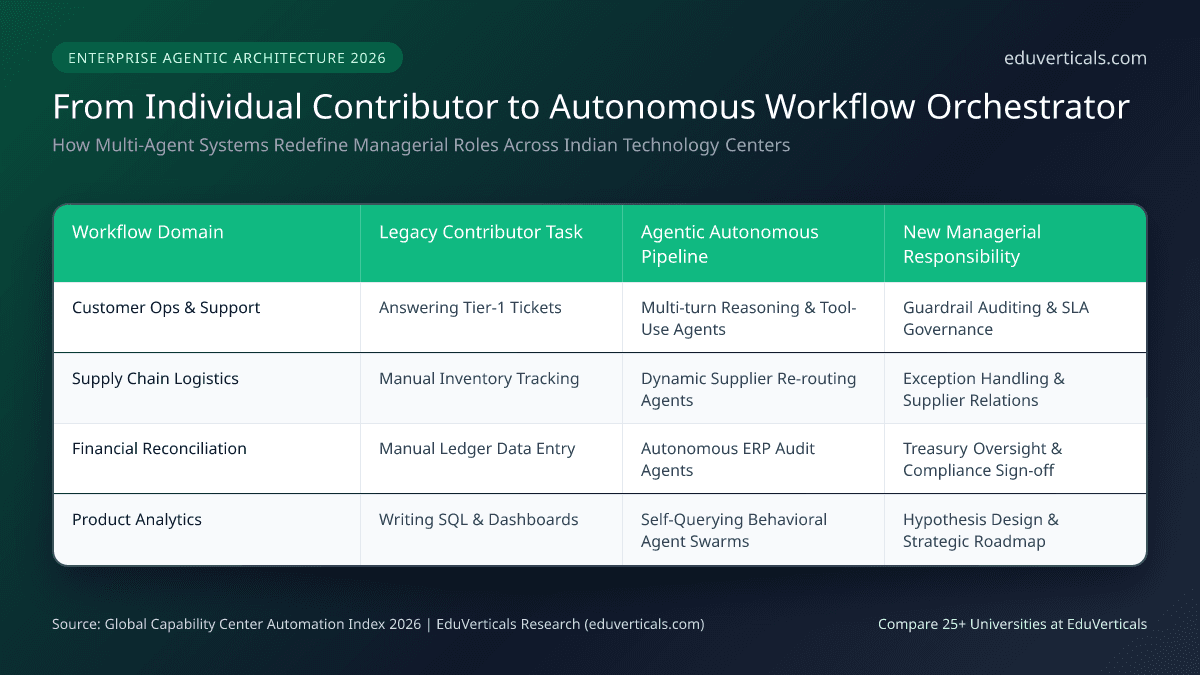
For decades, Indian software engineers, business analysts, and operations associates built lucrative careers through personal speed: writing SQL queries faster, debugging Java code faster, or reconciling spreadsheets faster. In 2026, raw human execution speed is economically irrelevant when a cluster of reasoning agents can execute three days of routine technical analysis in forty-five seconds.
As examined in our widely cited investigation, Will AI Replace the MBA Degree?, computational automation does not eliminate the need for leadership—it elevates it. The capabilities that machines lack are precisely the competencies taught in elite business curricula: stakeholder conflict resolution, ethical risk trade-offs, fiduciary accountability, and long-term capital allocation.
Select your career goal to tailor advice
Shift technical focus toward stateful multi-agent frameworks with authenticated API tools. Check our University Comparison Report to identify leading technical product management programs.
The emergence of multi-agent enterprise infrastructure has created lucrative new executive job families in Corporate India. Roles like Director of Autonomous Operations, Agentic Systems Architect, and GCC Workflow Transformation Head command salary packages ranging from ₹40 LPA to ₹75 LPA in multinational technology hubs.
Transitioning into these roles requires technical professionals to complement their engineering background with structured management credentials. Forward-looking engineers are enrolling in the Manipal University Jaipur (MUJ) Online MBA in IT & Analytics, which equips working leaders with the organizational design, technology strategy, and operational research skills required to oversee complex automated ecosystems.
Keep the details close
Explore key programme specifications, recognition terms, fee components, and career outcomes side by side before applying.
A chatbot produces a one-shot textual response to a user prompt. A reasoning agent executes autonomous multi-step planning, queries external databases via APIs, evaluates intermediate findings, and iteratively executes tasks to achieve a designated enterprise objective.
Bring programme options, estimated fees and study flexibility into one view, with the trade-offs and questions to verify.
Tailored shortlist from our admission partners. Verify fees and eligibility before applying.


We have a team of over 12 experienced mentors with over 26+ years of collective experience available to guide you at a moment's notice.