 EduVerticals Editorials
Posted 1 day ago

Executive SummaryReading BriefExecutive Summary: In November 2026, the transitional reporting phase of the European Union’s Carbon Border Adjustment Mechanism (CBAM) concluded, giving way to mandatory financial levy enforcement on carbon-intensive imports entering the European single market. For Indian heavy industry—which exports over $8.5 Billion worth of steel, aluminium, cement, and electrical equipment to Europe each year—the implementation of CBAM represents a massive geopolitical and financial shock. Because India’s heavy manufacturing sector relies predominantly on coal-fired electricity and blast-furnace basic oxygen furnace (BF-BOF) metallurgy, Indian flat steel and aluminium products face carbon border tariff penalties ranging between 18% and 35% based on prevailing EU Emissions Trading System (ETS) prices. To defend their global export competitiveness, Indian manufacturing giants (Tata Steel, JSW, Hindalco, Vedanta) and export-finance institutions are aggressively recruiting cross-functional leaders who combine metallurgical supply-chain literacy with Scope 1, 2, and 3 carbon accounting, green trade finance structuring, and international ESG regulatory compliance.
For seven decades, international trade economics was governed by comparative labor advantages, raw material proximity, and bilateral customs tariffs. The European Union’s CBAM framework has fundamentally rewritten those rules by introducing an environmental equalization tariff: foreign exporters must purchase digital CBAM certificates reflecting the exact carbon price that European domestic manufacturers pay under the EU Emissions Trading System (EU ETS).
For Indian industrial exporters, the challenge is structural. While European steelmakers have invested billions in electric arc furnaces (EAF) and direct reduced iron (DRI) pilot plants powered by green hydrogen, the Indian steel fleet remains heavily anchored in coal-based blast furnaces, producing between 2.3 and 2.6 tonnes of CO2 per tonne of crude steel—compared to the European benchmark of 1.3 to 1.5 tonnes. Without sophisticated decarbonization strategies and rigorous emissions auditing, Indian industrial exports risk being priced out of European supply chains.
Under the full financial implementation of CBAM in late 2026, the compliance process requires unprecedented corporate transparency:
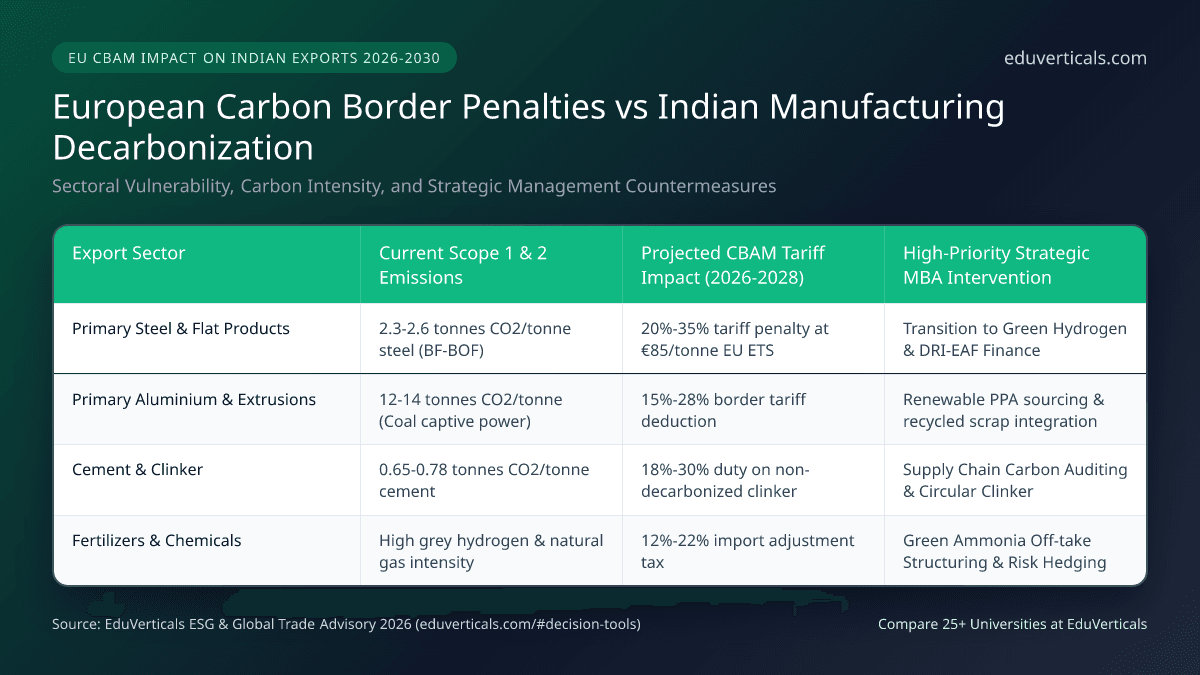
Indian manufacturing conglomerates are mounting an aggressive strategic response to defend their European market share:
Tata Steel, JSW Steel, and AM/NS India are accelerating multimillion-dollar investments in renewable power purchase agreements (PPAs), hydrogen-ready DRI technology, and increased utilization of recycled steel scrap. Simultaneously, non-ferrous producers like Hindalco and Vedanta are transitioning smelter power supplies to round-the-clock (RTC) hybrid renewable energy systems combining solar, wind, and pumped-hydro storage.
However, the primary barrier to rapid decarbonization is capital structuring and accounting compliance. Calculating embedded carbon across complex Tier-2 and Tier-3 supply chains requires specialized ERP integration, while funding green industrial transformations demands innovative financial instruments—including sustainability-linked bonds, green trade credit facilities, and bilateral carbon credit offset mechanisms.
Select your career goal to tailor advice
Master greenhouse gas protocol standards, life cycle assessment (LCA), and CBAM regulatory filing frameworks. Explore top options on EduVerticals.
Historically, corporate sustainability in India was relegated to corporate social responsibility (CSR) departments or treated as an environmental compliance checkbox managed by plant safety engineers. In 2026, sustainability is a direct driver of corporate revenue, EBITDA margins, and international credit ratings.
A single miscalculated emissions declaration on an export shipment of hot-rolled steel coils can trigger European customs impoundment, statutory audits, and punitive carbon levies running into millions of euros. Yet chemical, metallurgical, and mechanical engineers working inside manufacturing plants rarely possess training in international trade finance, corporate accounting, or carbon offset derivatives.
Engineers who bridge this knowledge gap by acquiring formal business education in financial modeling, supply chain analytics, and ESG governance are capturing high-paying Vice President of Sustainability, Head of ESG Trade Finance, and Director of Global Supply Chain roles with compensation packages exceeding ₹40L–₹75L.
Manufacturing engineers, finance managers, and international trade executives cannot step away from active corporate responsibilities to pursue two years of full-time campus studies. A flexible, UGC-DEB entitled Online MBA from premier institutions such as NMIMS CDOE or VIT Online provides the structured business acumen needed to lead corporate decarbonization strategies.
These accredited programmes offer comprehensive instruction in Corporate Finance, Global Supply Chain Management, Environmental Business Economics, and Strategic Risk Governance. Working professionals learn how to build dynamic carbon pricing models, navigate international trade treaties, and structure complex capital expenditure financing for industrial green transitions.
Explore specialized degree tracks and compare recognized university credentials on the EduVerticals Academic Catalog or test your projected career trajectory using .
Editorial BriefReading BriefLead the Global Green Trade Transition: Discover how top engineering and finance professionals are mastering sustainable trade finance and carbon accounting on EduVerticals Course Catalog.
Keep the details close
Explore key programme specifications, recognition terms, fee components, and career outcomes side by side before applying.
CBAM is a European Union policy imposing a carbon tariff on carbon-intensive imports (steel, aluminium, cement, fertilizer, hydrogen, electricity) to prevent carbon leakage, with mandatory financial certificate payments in full effect by late 2026.
Bring programme options, estimated fees and study flexibility into one view, with the trade-offs and questions to verify.
Tailored shortlist from our admission partners. Verify fees and eligibility before applying.


We have a team of over 12 experienced mentors with over 26+ years of collective experience available to guide you at a moment's notice.