
logo

Enterprise HR ERP Cloud Lock-In & Vendor Risk Management: Navigating Workday, SAP SuccessFactors, and SLA Audits in 2026

HR ERP Cloud Lock InWorkday SAP SuccessFactorsEnterprise HRIS Vendor RiskPeople Analytics StrategyHR Procurement AuditsEnterprise IT GovernanceHR Tech MBAEduVerticals
EduVerticals EditorialsEduVerticals Editorials

Posted 1 day ago

Enterprise HR ERP Cloud Lock-In & Vendor Risk Management: Navigating Workday, SAP SuccessFactors, and SLA Audits in 2026
Executive Summary
Reading Brief
Executive Summary: Over the past decade, Corporate India and multinational enterprises migrated their core human capital management from legacy on-premises servers to cloud-native Human Resource Information Systems (HRIS) like Workday, SAP SuccessFactors, and Oracle Cloud HCM. In late 2026, enterprise leaders face a harsh structural reality: acute vendor lock-in, multi-tenant cloud outages, aggressive 30% to 50% subscription renewal escalations, and strict regulatory liability under India’s Digital Personal Data Protection Act (DPDPA). Modern People Operations leaders must master enterprise procurement, SLA auditing, and IT risk governance to protect corporate balance sheets.

When enterprise software vendors initially pitched cloud HR ERP platforms, the value proposition seemed irresistible: zero server maintenance overhead, continuous automated feature rollouts, and seamless mobile self-service for tens of thousands of distributed employees. Companies enthusiastically dismantled their internal IT infrastructure and centralized their payroll, appraisal, recruitment, and attendance data into proprietary third-party cloud ecosystems.

However, once an organization with 15,000 to 100,000 employees fully integrates its global workflows into a cloud HRIS, switching costs become practically insurmountable. Migrating away from an established vendor requires 18 to 24 months of operational disruption, millions of dollars in systems integration consulting, and profound data migration risk. Recognizing this immense leverage, enterprise SaaS vendors have instituted steep price increases upon contract renewal, exposing corporate leadership to severe financial and operational vulnerabilities.

1. The Four Vulnerabilities of the Cloud HRIS Monopoly

Chief Human Resources Officers (CHROs) and enterprise procurement directors must contend with four distinct structural risks:
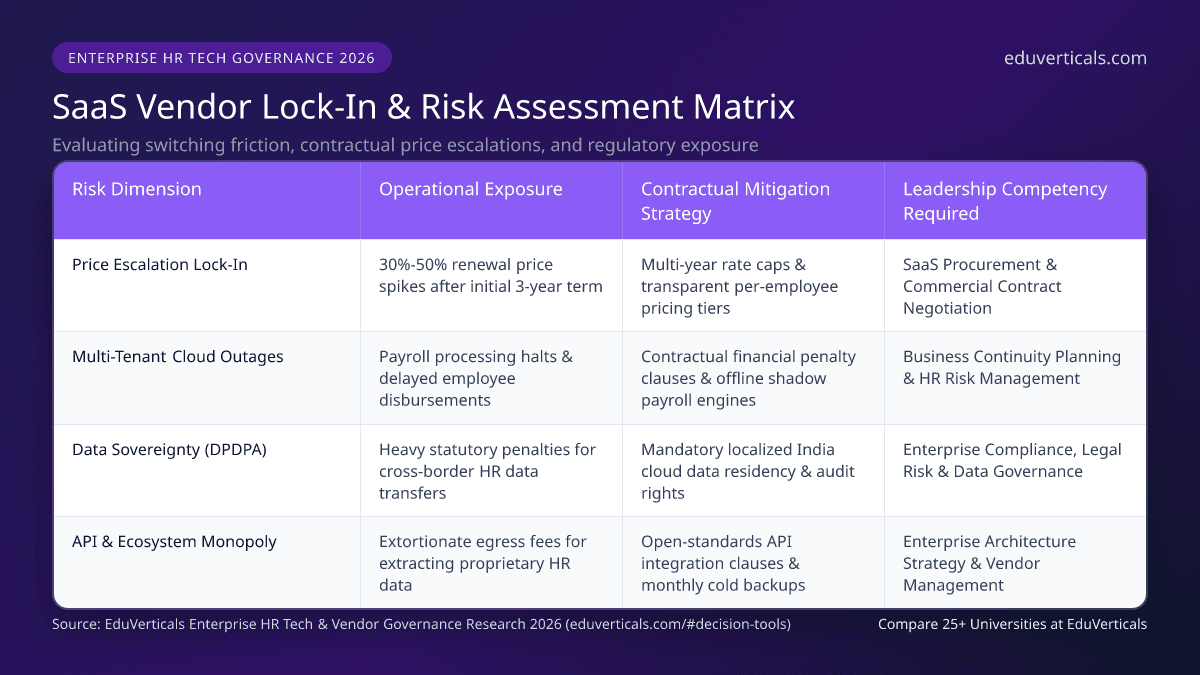
  1. Aggressive Renewal Price Escalations: Initial multi-year subscription contracts offer deep introductory discounts. Upon renewal, vendors frequently impose mandatory 25% to 45% price hikes, knowing that the cost of migration far exceeds the incremental software expense.
  2. Catastrophic Payroll Processing Outages: Multi-tenant cloud architecture means that an infrastructure glitch or misconfigured security patch at the vendor level can instantly paralyze payroll calculations, statutory Provident Fund (PF) deposits, and tax withholding across entire corporate workforces.
  3. Sovereign Compliance & DPDPA Exposure: Under India’s DPDPA 2023 and global data privacy mandates, enterprise employers are classified as "Data Fiduciaries." If a cloud vendor transfers biometric attendance records or sensitive employee financial records to overseas cloud clusters without statutory safeguards, the employer faces fines up to ₹250 Crore.
  4. Proprietary Data Lock-In & Egress Barriers: Vendors deliberately architect complex, non-standard database schemas, making historical performance analytics, compensation curves, and appraisal records exceedingly difficult to extract in standardized formats.
Enterprise HR ERP Cloud Lock In Vendor Risk 2026
Enterprise SaaS Vendor Lock-In & Risk Assessment Matrix: Managing Pricing Escalations, Uptime SLAs, and DPDPA Compliance.

2. Transforming HR from Traditional Support to Quantitative Risk Leadership

This operational environment has transformed the profile of successful HR executives. The era when human resources was treated purely as an administrative or culture-building function is dead. Modern enterprises require People Operations leaders who can dissect software license agreements, audit service level agreements (SLAs), and collaborate with legal and cybersecurity teams to establish contractual penalty clauses.

When an enterprise spends ₹30 Crore to ₹100 Crore annually on cloud software subscriptions, the CHRO must demonstrate hard financial discipline. Leaders must design hybrid redundancy mechanisms—such as running shadow payroll engines and maintaining encrypted, localized offline backups—to guarantee business continuity in the event of cloud provider downtime.

Interactive Career Pulse

Select your career goal to tailor advice

Decision note · Verified comparison01 / 03

Which enterprise HR tech leadership domain is most critical to your organization?

Mentor RecommendationSaaS Procurement & Vendor Negotiation

Master software contract law, rate-cap indexing, and enterprise IT asset procurement.

Tailored shortlist from our admission partners

3. Career Elevation: Mastering People Analytics & Enterprise Management

To command influence in modern corporate boardrooms, HR leaders must acquire formal cross-functional business training. An understanding of financial accounting, enterprise IT strategy, and operations research elevates an HR manager from an operational administrator into a strategic business partner.

Forward-thinking professionals are advancing their careers through accredited Online MBA programmes specializing in Human Resource Management and Business Analytics. Explore top institutions on the EduVerticals Academic Catalog and compare curriculums from Symbiosis Centre for Distance Learning (SSODL) and NMIMS Global Access.

  • Audit Cloud Vendor Contracts with Precision: Learn to negotiate strict liability terms, service credit penalties for downtime, and guaranteed price-increase caps.
  • Align People Analytics with Corporate P&L: Connect employee retention metrics, attrition costs, and payroll efficiency directly to corporate operating margins.
  • Design Resilient Enterprise Architectures: Collaborate with enterprise CIOs and CISOs to maintain localized data mirrors and disaster-recovery protocols.
  • Achieve Recognized Leadership Credentials: A recognized UGC-DEB entitled postgraduate degree confirms your readiness to oversee multi-functional enterprise transformation projects.
Decision Note
Reading Brief
Upgrade Your HR Leadership Trajectory: Discover how specialized executive management degrees empower you to lead enterprise HR tech procurement and digital transformation. Access our tailored shortlist from our admission partners on .

Keep the details close

Common QuestionsThe full picture.

Explore key programme specifications, recognition terms, fee components, and career outcomes side by side before applying.

05 verified FAQs

SaaS lock-in occurs when an enterprise becomes deeply dependent on a specific cloud HR platform (like Workday or SAP) due to proprietary data structures, custom integrations, and massive migration costs, giving the vendor disproportionate leverage to raise renewal prices.

01 / The Facts, Side by Side
Live Comparison Dossier

University Comparison Report

Bring programme options, estimated fees and study flexibility into one view, with the trade-offs and questions to verify.

01Fee Structure
02Study Mode
03Career Fit

Tailored shortlist from our admission partners. Verify fees and eligibility before applying.

Meet Our Mentors

We have a team of over 12 experienced mentors with over 26+ years of collective experience available to guide you at a moment's notice.

Got Questions?

Online and distance learning programs provide: - Flexibility to learn at your own pace from anywhere. - Access to recorded lectures and digital study materials. - Opportunities to balance work, education, and personal commitments. - Affordable options compared to traditional on-campus programs. - Industry-relevant curriculum designed by academic experts.
Choosing the right university depends on: - Accreditation and recognition of the institution. - Quality and relevance of the curriculum. - Availability of academic and career support services. - Feedback and reviews from alumni and current students. - Flexibility in learning schedules and delivery modes.
Yes, online degrees from accredited universities are widely recognized and equivalent to regular degrees. Employers value the skills and qualifications gained from online programs, especially when offered by reputed institutions.
Assessment methods for online programs vary but typically include: - Online quizzes and assignments. - Virtual proctored exams. - Group projects and case studies. - Real-time presentations and viva sessions.
Many universities allow credit transfers, subject to: - Compatibility with the curriculum of the new program. - A minimum grade requirement in previously completed courses. - Approval by the academic administration of the new university.