 EduVerticals Editorials
Posted 4 months ago
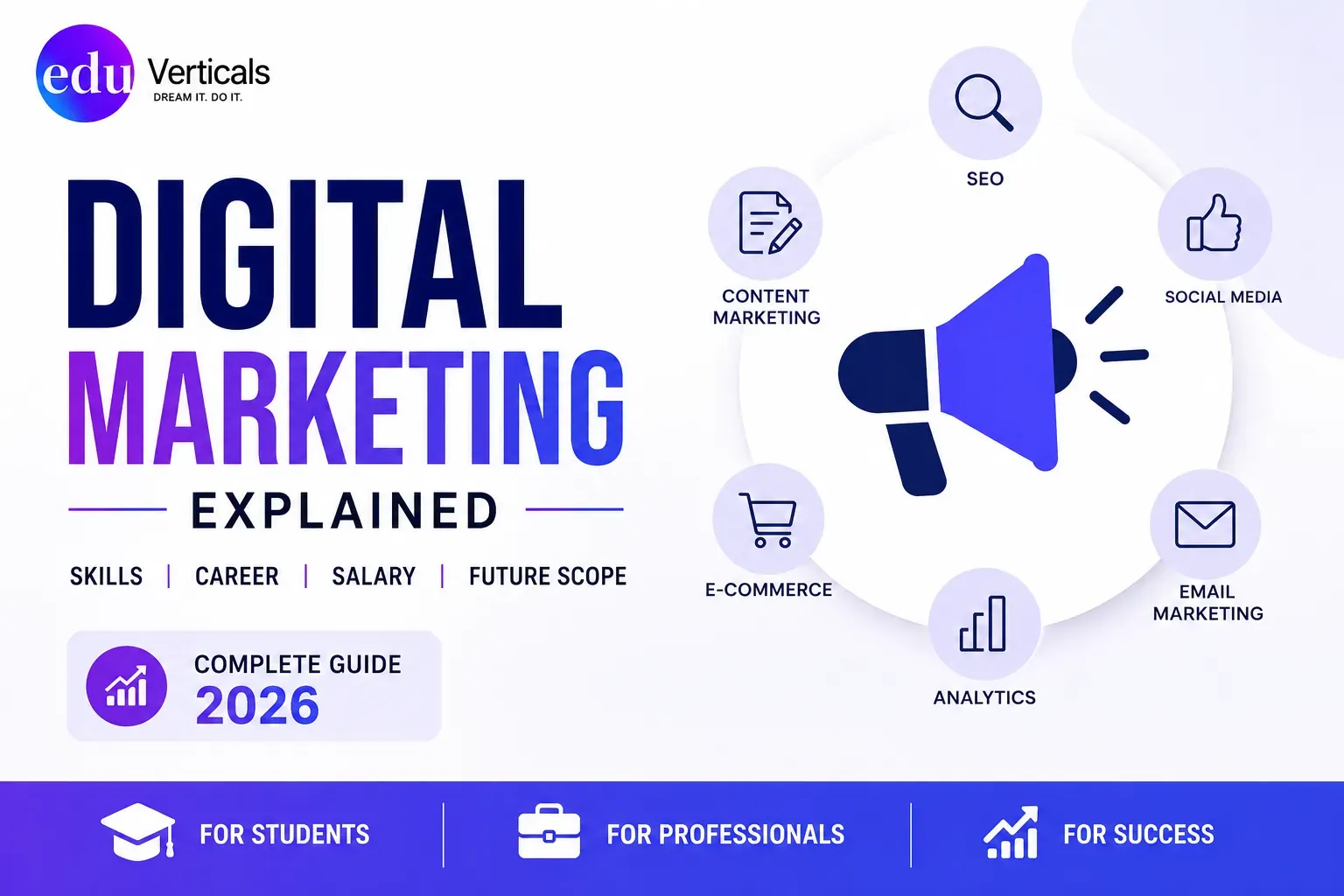
Digital marketing is no longer just a business function. It has become one of the most valuable professional skills in the modern economy.
Every day, billions of people search on Google, scroll through social media, watch videos, read emails, shop online, and interact with brands digitally. Behind every successful online interaction is a digital marketing strategy designed to attract, engage, and convert customers.
Whether you are a student exploring career opportunities, a working professional looking to upskill, an entrepreneur building a business, or someone considering a career transition, understanding digital marketing has become increasingly important.
In this comprehensive guide, we will explore what digital marketing is, how it works, its major channels, career opportunities, salary expectations, required skills, and the future of digital marketing in 2026 and beyond.
Digital marketing refers to the promotion of products, services, brands, or businesses through digital channels and online platforms.
Unlike traditional marketing, which relies on television, newspapers, billboards, and radio advertisements, digital marketing uses internet-based platforms to reach and engage audiences.
These platforms include:
- Search engines
- Social media networks
- Websites
- Mobile applications
- Online marketplaces
- Video-sharing platforms
The primary objective of digital marketing is to connect businesses with the right audience at the right time using measurable and data-driven strategies.
Because consumer behavior has shifted dramatically toward online platforms, digital marketing has become one of the fastest-growing fields worldwide.
The modern customer journey begins online.
Before making a purchase decision, consumers typically search for information, compare options, read reviews, watch videos, and engage with brands through multiple digital touchpoints.
This shift has made digital marketing essential for businesses of every size.
Organizations today invest heavily in:
- Search Engine Optimization (SEO)
- Paid Advertising (PPC)
- Social Media Marketing
- Content Marketing
- Email Marketing
- Influencer Marketing
- Marketing Automation
As artificial intelligence continues transforming customer experiences, digital marketers who understand both technology and consumer psychology are becoming increasingly valuable.
Digital marketing works by guiding potential customers through different stages of the buyer's journey.
The process typically begins when a user discovers a brand through a search engine, social media platform, advertisement, or referral.
Once attention is captured, businesses provide valuable content that educates or solves a problem.
Over time, this builds trust and encourages users to take desired actions such as:
- Making a purchase
- Submitting a lead form
- Booking a consultation
- Downloading a resource
- Subscribing to a newsletter
The biggest advantage of digital marketing is measurability.
Unlike traditional marketing, marketers can track impressions, clicks, conversions, revenue, engagement, and customer behavior in real time.
Search Engine Optimization is the process of improving a website's visibility in search engine results.
When users search for information on Google, SEO helps businesses appear organically without paying for advertisements.
SEO involves:
- Keyword research
- Technical optimization
- Content creation
- Backlink building
- User experience improvements
For example, a university may optimize pages targeting terms such as "Online MBA Programs" or "Best MBA Colleges in India."
You can explore our detailed guide on Online MBA programs and career opportunities .
Content marketing focuses on creating valuable and relevant content that attracts and educates audiences.
Examples include:
- Blog articles
- Guides
- Videos
- Podcasts
- Case studies
- Whitepapers
High-quality content helps businesses build authority while supporting SEO and lead generation efforts.
Social media marketing involves promoting brands through platforms such as:
- X
- YouTube
- Threads
Brands use social media to build awareness, engage audiences, generate leads, and create communities.
Social media has become one of the most influential digital marketing channels because it combines content distribution, audience engagement, and paid advertising opportunities.
PPC advertising allows businesses to display advertisements on search engines and social media platforms.
Advertisers only pay when users click on their ads.
Popular PPC platforms include:
- Google Ads
- Meta Ads
- LinkedIn Ads
- YouTube Ads
PPC provides immediate visibility and is particularly useful for generating leads and sales quickly.
Despite being one of the oldest digital marketing channels, email marketing remains among the highest-performing methods for customer retention.
Businesses use email campaigns to:
- Nurture leads
- Promote products
- Share updates
- Build customer loyalty
Well-structured email marketing campaigns consistently deliver strong return on investment.
Affiliate marketing allows individuals or organizations to earn commissions by promoting products or services through referral links.
Many content creators, bloggers, and influencers generate income using affiliate partnerships.
Influencer marketing involves collaborating with creators who have established credibility and audience trust.
Brands increasingly use influencer partnerships to reach highly targeted communities and improve brand awareness.
Successful digital marketers combine creativity with analytical thinking.
Some of the most valuable skills include:
- SEO
- Content Strategy
- Copywriting
- Social Media Management
- Data Analytics
- Google Analytics
- Marketing Automation
- AI Tools
- Paid Advertising
- Conversion Rate Optimization
The growing role of AI means professionals must also learn how to leverage automation tools effectively rather than competing against them.
The digital marketing ecosystem includes hundreds of tools.
Among the most widely used are:
- Google Analytics
- Google Search Console
- Google Ads
- Meta Ads Manager
- HubSpot
- SEMrush
- Ahrefs
- Canva
- Mailchimp
- Notion
Employers increasingly expect candidates to have practical familiarity with these platforms.
Digital marketing offers diverse career paths across industries.
Popular roles include:
- SEO Specialist
- Content Strategist
- Social Media Manager
- PPC Specialist
- Performance Marketer
- Email Marketing Specialist
- Marketing Analyst
- Growth Marketer
- Digital Marketing Manager
Demand continues growing because every business now requires an online presence.
Industries actively hiring digital marketing professionals include education, healthcare, technology, finance, retail, real estate, and e-commerce.
Digital marketing salaries vary depending on skills, specialization, location, and experience.
Freshers entering the field typically earn competitive entry-level salaries, while experienced professionals with expertise in SEO, paid advertising, analytics, and growth marketing can command significantly higher compensation.
Specializations such as performance marketing, marketing automation, and AI-driven analytics are expected to experience the strongest salary growth in the coming years.
The future of digital marketing is increasingly influenced by artificial intelligence, automation, personalization, and data-driven decision-making.
Emerging trends include:
- AI-generated content
- Predictive analytics
- Voice search optimization
- Conversational marketing
- Personalization at scale
- Video-first marketing
- Creator economy growth
However, technology does not eliminate the need for marketers.
Instead, it increases the demand for professionals who can combine strategic thinking, creativity, and technological expertise.
The marketers who thrive will be those who understand both people and technology.
Yes.
Digital marketing remains one of the most accessible and future-oriented career paths available today.
It offers:
- Strong job demand
- Diverse specialization options
- Freelancing opportunities
- Remote work flexibility
- Entrepreneurial applications
- Continuous growth potential
For students and working professionals seeking a career that combines creativity, business strategy, data analysis, and technology, digital marketing presents a compelling opportunity.
The best approach is to combine theoretical knowledge with practical application.
Start by learning:
- SEO fundamentals
- Content marketing
- Social media marketing
- Paid advertising
- Analytics
Then build hands-on experience by creating projects, blogs, websites, campaigns, or personal brands.
If you are planning to pursue higher education while developing industry-relevant skills, explore the online degree programs and professional development resources available through EduVerticals.
Digital marketing has transformed from a specialized function into a core business capability.
As businesses continue investing in digital channels, professionals with digital marketing expertise will remain in high demand across industries.
Whether your goal is career growth, entrepreneurship, freelancing, or business development, digital marketing provides skills that are relevant, practical, and future-ready.
The most successful digital marketers are not simply experts in tools. They understand audiences, solve problems, create value, and use technology to deliver meaningful results.
As we move further into the AI era, those capabilities will become even more valuable.


We have a team of over 12 experienced mentors with over 26+ years of collective experience available to guide you at a moment's notice.