 EduVerticals Editorials
Posted 4 months ago
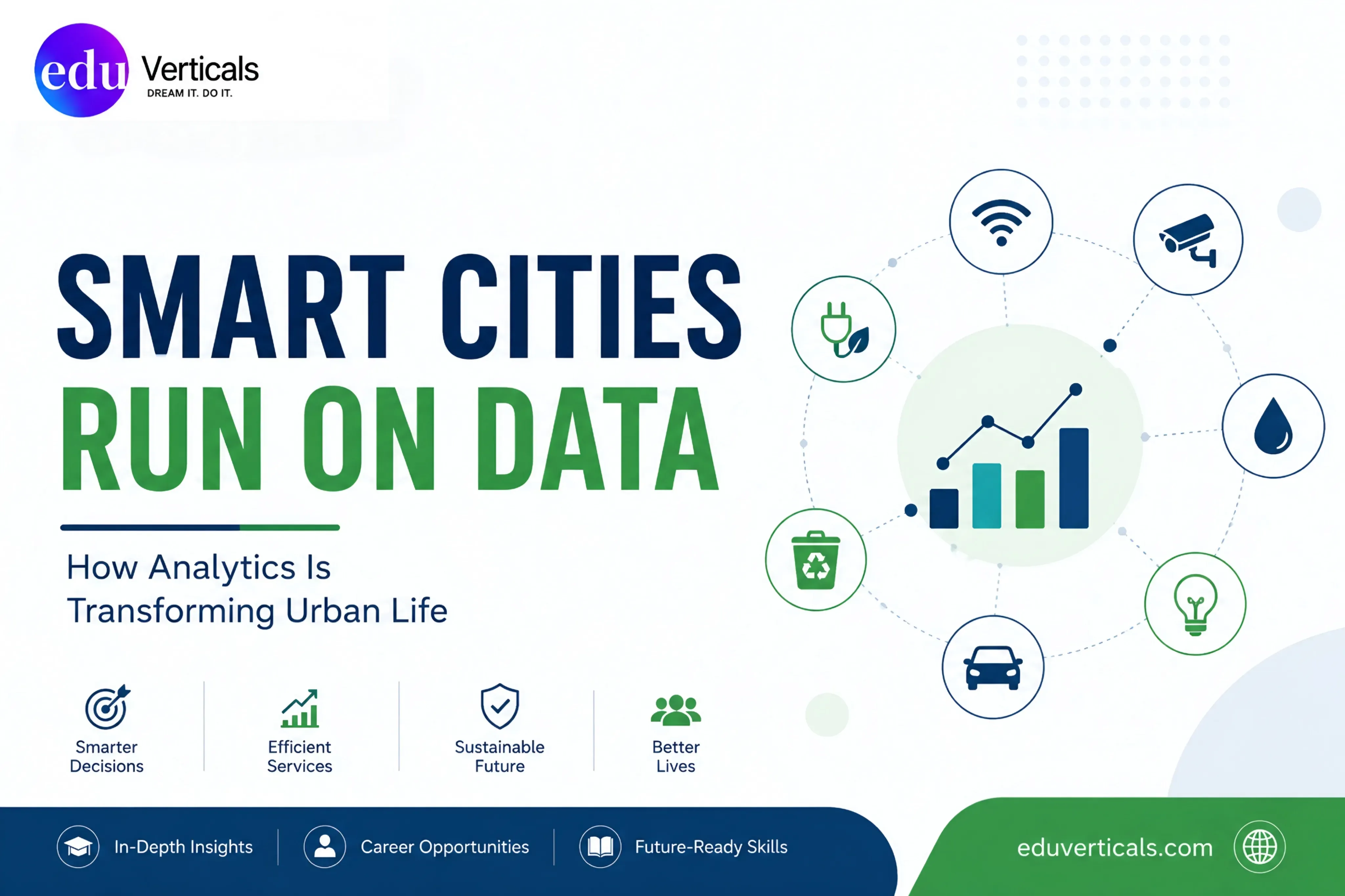
Cities are growing faster than ever before. With increasing populations, rising traffic congestion, growing energy demands, and pressure on public services, traditional urban management methods are no longer enough. To address these challenges, governments and urban planners are embracing the concept of smart cities.
At the heart of every smart city lies data. From traffic signals and surveillance cameras to electricity grids and water supply systems, modern cities generate enormous amounts of information every second. Data analytics helps transform this information into actionable insights that improve efficiency, sustainability, and quality of life.
In this article, we explore the role of data analytics in smart cities, its applications, benefits, challenges, and the exciting career opportunities emerging in this field.
A smart city uses technology, data, and digital infrastructure to improve urban services and enhance the lives of residents. Smart cities leverage connected devices, sensors, communication networks, and advanced analytics to make informed decisions in real time.
The goal of a smart city is to create a safer, more sustainable, efficient, and citizen-centric urban environment.
Some common characteristics of smart cities include:
- Intelligent transportation systems
- Smart energy management
- Digital governance
- Smart healthcare services
- Efficient waste management
- Real-time public safety monitoring
- Sustainable environmental practices
Examples of global smart cities include Singapore, Barcelona, Amsterdam, and Copenhagen. In India, initiatives under the Smart Cities Mission have accelerated the adoption of technology-driven urban development.
Data analytics refers to the process of collecting, organizing, analyzing, and interpreting data to uncover patterns, trends, and actionable insights.
Organizations use data analytics to make informed decisions, predict future outcomes, optimize operations, and improve overall performance.
The four major types of data analytics include:
1. Descriptive Analytics
Answers the question: What happened?
Example: Monitoring daily traffic volume across city roads.
2. Diagnostic Analytics
Answers the question: Why did it happen?
Example: Identifying the cause of increased traffic congestion in a specific area.
3. Predictive Analytics
Answers the question: What is likely to happen?
Example: Forecasting traffic patterns during festivals or public events.
4. Prescriptive Analytics
Answers the question: What should be done?
Example: Suggesting alternative traffic routes to reduce congestion.
In smart cities, these analytical approaches help administrators make data-driven decisions that improve urban management.
Modern cities generate data from multiple sources, including:
- IoT sensors
- GPS devices
- CCTV cameras
- Mobile applications
- Smart meters
- Public transportation systems
- Environmental monitoring stations
- Government databases
Without analytics, this data remains unused.
Data analytics converts raw information into valuable insights that help city authorities:
- Improve resource allocation
- Enhance public services
- Predict future problems
- Reduce operational costs
- Improve sustainability
- Increase citizen satisfaction
Simply put, data analytics acts as the intelligence layer that enables smart cities to function effectively.
Traffic congestion is one of the biggest challenges faced by urban areas.
Data analytics helps cities:
- Monitor traffic flow in real time
- Optimize traffic signal timings
- Identify congestion hotspots
- Predict peak traffic hours
- Suggest alternate routes
Cities can use AI-powered analytics to reduce travel times and improve transportation efficiency.
Energy consumption continues to rise as cities expand.
Analytics helps utility providers:
- Monitor electricity usage patterns
- Detect power outages faster
- Forecast future demand
- Reduce energy wastage
- Optimize renewable energy integration
Smart grids powered by data analytics improve energy efficiency while reducing costs.
Water scarcity and leakage are major concerns for many cities.
Analytics solutions help authorities:
- Detect leaks in pipelines
- Monitor water quality
- Predict consumption patterns
- Improve distribution efficiency
This ensures sustainable water management and reduces resource wastage.
Traditional waste collection systems often result in inefficiencies.
Using analytics, cities can:
- Monitor fill levels in waste bins
- Optimize collection routes
- Reduce fuel consumption
- Improve recycling efforts
This leads to cleaner cities and lower operational costs.
Modern surveillance systems generate vast amounts of video data.
Data analytics can:
- Detect unusual activities
- Identify high-risk zones
- Improve emergency response times
- Support crime prevention efforts
AI-powered monitoring systems are increasingly becoming a vital component of urban safety strategies.
Smart healthcare systems use analytics to:
- Monitor disease outbreaks
- Improve hospital resource allocation
- Track public health trends
- Support emergency medical services
During health emergencies, real-time analytics can help authorities respond more effectively.
Cities face growing environmental challenges such as pollution and climate change.
Analytics enables authorities to:
- Track air quality levels
- Monitor noise pollution
- Analyze weather patterns
- Assess environmental risks
This supports sustainable urban development initiatives.
IoT devices continuously collect real-time data from various city systems.
Examples include:
- Traffic sensors
- Smart meters
- Environmental sensors
- Connected public infrastructure
Artificial Intelligence and Machine Learning
AI algorithms analyze massive datasets and identify patterns that humans may miss.
Machine learning supports:
- Predictive maintenance
- Traffic forecasting
- Demand prediction
- Anomaly detection
Cloud platforms provide scalable infrastructure for storing and processing large volumes of data generated by smart cities.
High-speed communication networks enable faster data transmission and real-time analytics.
This is critical for applications such as autonomous vehicles and connected infrastructure.
Big data technologies help process and analyze large-scale datasets efficiently, supporting complex decision-making processes.
Improved Operational Efficiency
Analytics enables better resource management and process optimization.
Cost Reduction
Data-driven decisions reduce waste, lower maintenance costs, and improve budget utilization.
Better Citizen Experience
Residents benefit from improved transportation, safer streets, and enhanced public services.
Sustainability
Analytics supports responsible use of energy, water, and environmental resources.
Faster Decision-Making
Real-time insights allow authorities to respond quickly to emerging challenges.
Enhanced Urban Planning
Data-driven planning helps cities prepare for future growth and development.
While the benefits are significant, several challenges remain.
Data Privacy Concerns
Large-scale data collection raises concerns regarding citizen privacy and data protection.
Cybersecurity Risks
Smart city infrastructure can become a target for cyberattacks if proper security measures are not implemented.
High Implementation Costs
Deploying sensors, networks, and analytics platforms requires substantial investment.
Integration Complexity
Combining data from multiple systems and departments can be technically challenging.
Skill Shortage
There is growing demand for professionals with expertise in analytics, AI, cybersecurity, and smart infrastructure.
Addressing these challenges is essential for the successful development of smart cities.
The expansion of smart city initiatives is creating strong demand for skilled professionals.
Popular career roles include:
- Data Analyst
- Business Analyst
- Data Scientist
- Urban Data Specialist
- Smart City Consultant
- IoT Analyst
- Machine Learning Engineer
- GIS Analyst
- Transportation Data Analyst
- Public Policy Analyst
Industries hiring these professionals include:
- Government agencies
- Infrastructure companies
- Technology firms
- Consulting organizations
- Energy providers
- Transportation companies
- Telecommunications companies
Professionals with skills in data analytics, AI, cloud computing, and visualization tools are likely to remain highly sought after in the coming years.
The future of urban development will increasingly depend on intelligent decision-making powered by data.
Emerging technologies such as:
- Artificial Intelligence
- Digital Twins
- Edge Computing
- Autonomous Vehicles
- Predictive Analytics
- Generative AI
will further enhance the capabilities of smart cities.
As governments continue investing in digital infrastructure, data analytics will become a critical component of urban transformation worldwide.
Smart cities represent the future of urban living, and data analytics is the engine that powers them. By transforming raw information into actionable insights, analytics helps cities improve transportation, energy management, public safety, healthcare, environmental sustainability, and overall quality of life.
As the adoption of smart city technologies accelerates, the demand for skilled data analytics professionals will continue to grow. For students and working professionals looking to build a future-ready career, developing expertise in data analytics can open doors to exciting opportunities across industries.
The cities of tomorrow will not simply be connected—they will be intelligent, responsive, and driven by data. Understanding data analytics today is a step toward shaping that future.


We have a team of over 12 experienced mentors with over 26+ years of collective experience available to guide you at a moment's notice.