 EduVerticals Editorials
Posted 1 day ago

Executive SummaryReading BriefExecutive Summary: The global expansion of NPCI International Payments Limited (NIPL)—interlinking India’s Unified Payments Interface (UPI) with national payment switches across Singapore (PayNow), the United Arab Emirates (Aani), France (Worldline), Mauritius, and Sri Lanka—has fundamentally disrupted cross-border finance. International payments that once took 48 to 72 hours and extracted 5% to 7% in opaque correspondent banking fees now settle in under 15 seconds at a fraction of the cost. Yet scaling real-time digital trade corridors into multi-billion-dollar commercial ecosystems requires far more than open API protocols. Commercial banks, FinTech unicorns, and global payment processors are competing fiercely to hire specialized FinTech product directors, cross-border treasury leads, and compliance executives capable of managing multi-currency liquidity, combating synthetic identity fraud, and harmonizing disparate central bank regulatory frameworks.
Over the past eight years, the Unified Payments Interface (UPI) revolutionized India’s domestic retail economy, processing over 15 billion transactions monthly with world-leading reliability. But in late 2026, the geopolitical and economic frontier of payments has moved decisively cross-border. Through bilateral agreements spearheaded by the Reserve Bank of India (RBI) and NIPL, India is actively challenging the decades-old monopoly of Western correspondent banking networks and the SWIFT messaging system.
For multinational trade houses, Indian MSME exporters, and 35 million Non-Resident Indians (NRIs), real-time cross-border settlements eliminate currency conversion opacity and working capital gridlock. However, executing cross-border payments at scale introduces complex institutional risks: bilateral foreign exchange liquidity management, automated Anti-Money Laundering (AML) monitoring, and compliance with the Financial Action Task Force (FATF) Travel Rule. The fintech sector no longer needs pure app developers; it demands multidisciplinary leaders who understand monetary economics, banking law, and enterprise product management.
Traditional international wire transfers rely on correspondent banking networks, where a payment bounces through multiple intermediary banks, each deducting an administrative fee and adding settlement delays. Real-time bilateral corridor linkages bypass this friction entirely.
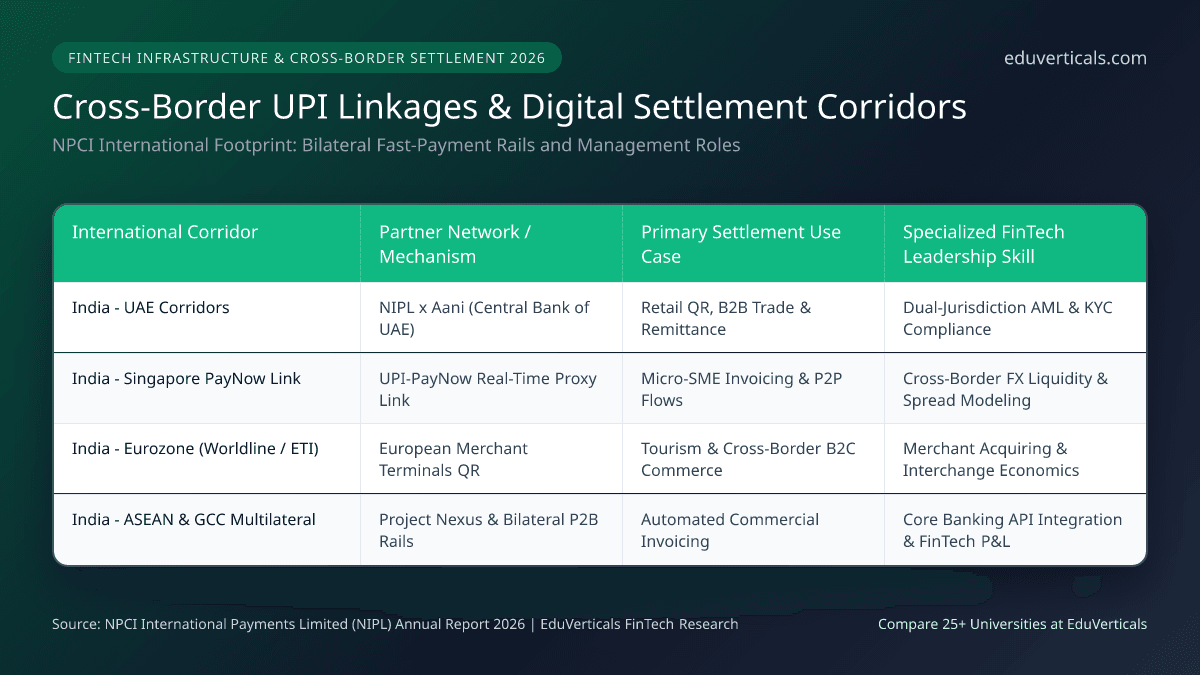
The proliferation of cross-border payment corridors has catalyzed an unprecedented hiring boom across global payments processors, digital neo-banks, and legacy financial institutions. Enterprises are creating entirely new organizational functions that bridge technical engineering and institutional banking.
Annual compensation packages for cross-border payments product managers, risk directors, and treasury leads range from ₹40 LPA to ₹85 LPA, reflecting the scarcity of professionals who understand both technical API architecture and the nuances of RBI foreign exchange management regulations (FEMA).
Select your career goal to tailor advice
Design seamless cross-border payment UX and merchant flows. Review top programs in the University Comparison Report or book a Free Mentor Call.
As commercial banks and FinTech unicorns expand their global settlement infrastructure, technical professionals frequently hit a promotional ceiling. An engineering lead who builds payment APIs cannot easily advance to Head of FinTech Product or Chief Risk Officer without proving formal competency in banking law, corporate financial risk, and strategic enterprise management.
This career inflection point is driving experienced software engineers, compliance analysts, and banking officers toward accredited UGC-DEB entitled Online MBAs in FinTech and Financial Management. Top institutions such as Vellore Institute of Technology (VIT Online) offer cutting-edge curricula covering digital banking architecture, blockchain economics, algorithmic trading, and international financial regulations.
Because these programs feature flexible weekend schedules and digital case studies, professionals can acquire comprehensive institutional finance literacy without interrupting their full-time corporate roles. To explore specialized FinTech and Banking curricula, consult the EduVerticals Academic Catalog or compare approved degrees in our EduVerticals Course Catalog.
Editorial BriefReading BriefLead the Digital Payments Transformation: Compare premier UGC-DEB accredited Online MBA programs in FinTech, Banking, and Corporate Finance on .
Keep the details close
Explore key programme specifications, recognition terms, fee components, and career outcomes side by side before applying.
SWIFT is a financial messaging protocol that relies on multiple intermediary correspondent banks, taking 2 to 3 days and charging high fees. Cross-border UPI uses direct bilateral and multilateral API switches between central banks, settling funds in under 15 seconds at near-zero intermediary costs.
Bring programme options, estimated fees and study flexibility into one view, with the trade-offs and questions to verify.
Tailored shortlist from our admission partners. Verify fees and eligibility before applying.


We have a team of over 12 experienced mentors with over 26+ years of collective experience available to guide you at a moment's notice.