 EduVerticals Editorials
Posted 1 day ago
Executive SummaryReading BriefExecutive Summary: In November 2026, the global automotive and clean energy transition collided with an aggressive wave of critical mineral protectionism. As South America’s "Lithium Triangle" established state-controlled marketing consortiums, Indonesia broadened export restrictions on processed battery nickel, and China tightened export quotas on advanced synthetic graphite and rare-earth magnet technologies, automotive original equipment manufacturers (OEMs) and grid storage developers faced severe supply disruptions. For Indian automotive giants—including Tata Motors, Mahindra & Mahindra, Ola Electric, and JSW Energy—battery procurement is no longer a standard purchasing function handled by junior buyers. It has transformed into an executive boardroom imperative requiring sophisticated commodity hedging, international joint-venture governance, and multi-tier supply chain resilience.
Electric vehicles are fundamentally batteries on wheels; the battery pack accounts for 35% to 45% of the total bill of materials for an electric passenger car or commercial bus. Yet while automotive assembly occurs domestically across manufacturing corridors in Pune, Chennai, and Sanand, the underlying chemistry of lithium nickel manganese cobalt oxide (NMC) and lithium iron phosphate (LFP) relies on a deeply concentrated global upstream mineral matrix.
Over the past two years, resource nationalism has replaced free-market globalization. Governments in mineral-rich jurisdictions are leveraging export duties, mandatory domestic value-addition laws, and bilateral government-to-government quotas to capture a larger share of clean energy value. To survive in this volatile landscape, automotive enterprises must cultivate leaders who possess both metallurgical engineering literacy and sophisticated financial risk management capabilities.
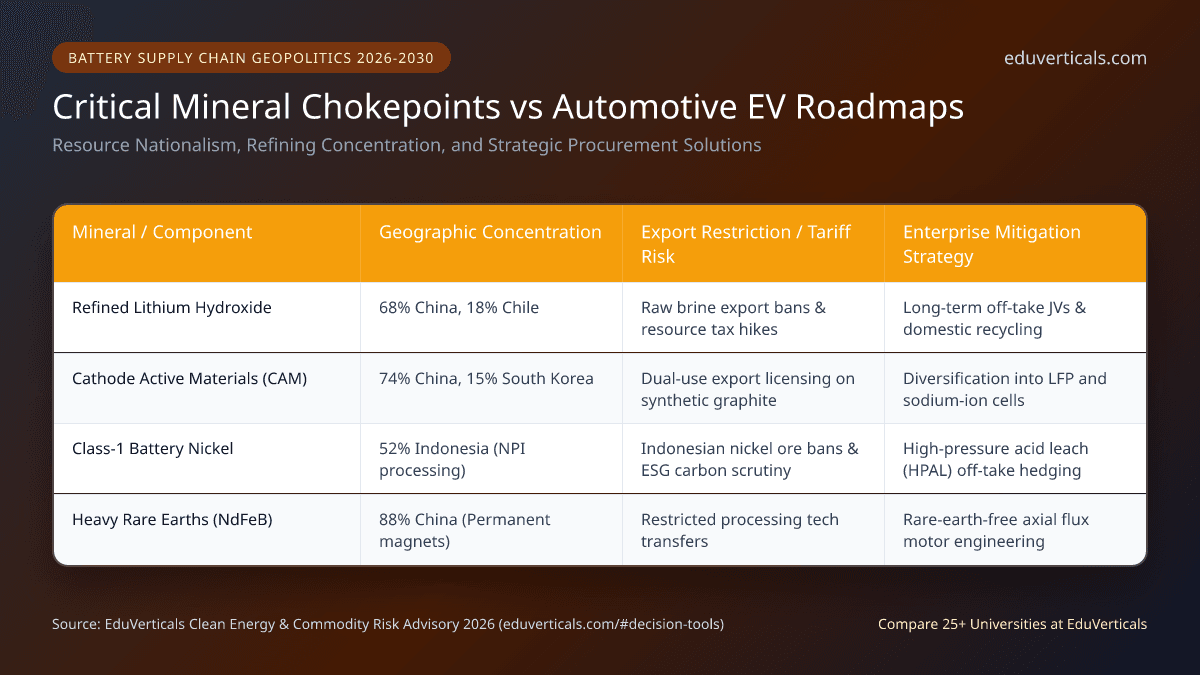
The vulnerabilities facing global EV battery manufacturers in late 2026 are rooted in extreme geographical and processing bottlenecks:
India has responded to these vulnerabilities through a combination of domestic manufacturing incentives and state-backed international mineral exploration. Under the Advanced Chemistry Cell (ACC) Production-Linked Incentive (PLI) scheme, over 50 GWh of domestic cell manufacturing capacity is currently under construction by Reliance New Energy, Ola Electric, Rajesh Exports, and Amara Raja.
Simultaneously, Khanij Bidesh India Limited (KABIL)—a joint venture between NALCO, HCL, and MECL—has acquired lithium brine exploration blocks in Argentina and signed strategic mineral off-take pacts in Australia. However, converting these diplomatic concessions into operational battery packs requires strategic procurement professionals who can manage cross-border shipping logistics, secure currency hedging against exchange rate fluctuations, and audit environmental, social, and governance (ESG) compliance along the supply chain.
Select your career goal to tailor advice
Master commodity futures, off-take contracting, and vendor scorecards to step into Chief Procurement Officer (CPO) roles. Compare top programmes on EduVerticals.
Traditionally, corporate procurement in the automotive sector was treated as an operational support function focused on driving down supplier prices on stamped steel, plastic moldings, and wiring harnesses. In the EV era, that model has collapsed entirely. A 20% swing in raw lithium hydroxide prices or a sudden export restriction on synthetic graphite can erase an automaker’s annual gross profit margins overnight.
As a result, leading automakers and battery manufacturers are actively recruiting procurement heads who operate as strategic risk managers. These executives build dynamic hedging models using London Metal Exchange (LME) contracts, negotiate multi-year index-linked off-take agreements, and establish strategic buffer inventories.
Technical automotive engineers who supplement their mechanical or electrical engineering backgrounds with an accredited postgraduate business qualification are ideally positioned to capture these high-value leadership posts, commanding compensation packages exceeding ₹40L–₹70L.
Balancing a demanding supply chain role while preparing for executive leadership requires educational flexibility. An accredited, UGC-DEB entitled Online MBA from premier institutions such as NMIMS CDOE or Manipal University Jaipur (MUJ) allows procurement engineers and supply chain supervisors to acquire world-class management training without stepping away from active operations.
Curriculum modules in Global Supply Chain Strategy, Financial Derivatives, Operations Analytics, and International Trade Law equip working professionals to participate in high-stakes vendor negotiations and boardroom capital planning meetings. Furthermore, NAAC A++ accreditation ensures that the degree holds rigorous corporate credibility across multinational conglomerates.
Explore specialized degree tracks and compare curriculum details on the EduVerticals Academic Catalog or project your potential career return on investment using the .
Editorial BriefReading BriefShape the Future of Sustainable Mobility: Discover how top engineering professionals are mastering clean energy procurement and operations on EduVerticals Course Catalog.
Keep the details close
Explore key programme specifications, recognition terms, fee components, and career outcomes side by side before applying.
Export restrictions, export taxes, and refining quotas on lithium, nickel, and graphite create pricing volatility that can swing total battery pack costs by 15% to 25%, directly impacting EV showroom pricing and OEM profitability.
Bring programme options, estimated fees and study flexibility into one view, with the trade-offs and questions to verify.
Tailored shortlist from our admission partners. Verify fees and eligibility before applying.


We have a team of over 12 experienced mentors with over 26+ years of collective experience available to guide you at a moment's notice.