 EduVerticals Editorials
Posted 1 day ago

Executive SummaryReading BriefExecutive Summary: Coal India Limited’s landmark ₹10,000 Crore initial public offering (IPO) filing for its crown-jewel subsidiary, Mahanadi Coalfields Limited (MCL), marks a watershed transition in public sector undertaking (PSU) modernization. Beyond unlocking immense equity value, listing a PSU subsidiary subjects state enterprises to stringent SEBI LODR compliance, quarterly capital allocation scrutiny, and institutional governance. For public sector engineers and administrative officers, Department of Public Enterprises (DPE) performance guidelines increasingly mandate accredited postgraduate management qualifications for promotion into board-level and general management cadres.
In November 2026, India’s public sector energy landscape reached a monumental inflection point. Mahanadi Coalfields Limited—the Sambalpur-headquartered coal producer generating over 200 million tonnes of annual output and accounting for a massive share of Coal India’s consolidated operating profits—advanced its ₹10,000 Crore disinvestment listing. This milestone mirrors the broader central government strategy to monetize non-core and subsidiary public equity while preserving state majority control.
Yet the listing of a public enterprise is not merely a capital market spectacle. It structurally alters the operational DNA of the enterprise. The moment a PSU becomes a publicly traded corporate entity, bureaucratic administrative routines must give way to strict fiduciary responsibility, return on equity (ROE) benchmarks, and institutional shareholder accountability.
For decades, central public sector enterprises (CPSEs) operated as unified holding corporations where highly profitable mining or manufacturing units quietly subsidized underperforming regional divisions. By unbundling and listing Mahanadi Coalfields as an independent market entity, the Ministry of Coal and Coal India are establishing dedicated price discovery for high-efficiency opencast assets.
This capital restructuring creates compelling benefits: it generates substantial non-tax revenues for the national exchequer, enforces independent board oversight, and equips the subsidiary with direct equity currency to fund advanced coal gasification, conveyor electrification, and renewable solar installations. However, this transition requires operational executives to understand financial markets, cost-of-capital hurdles, and Ind AS accounting standards.
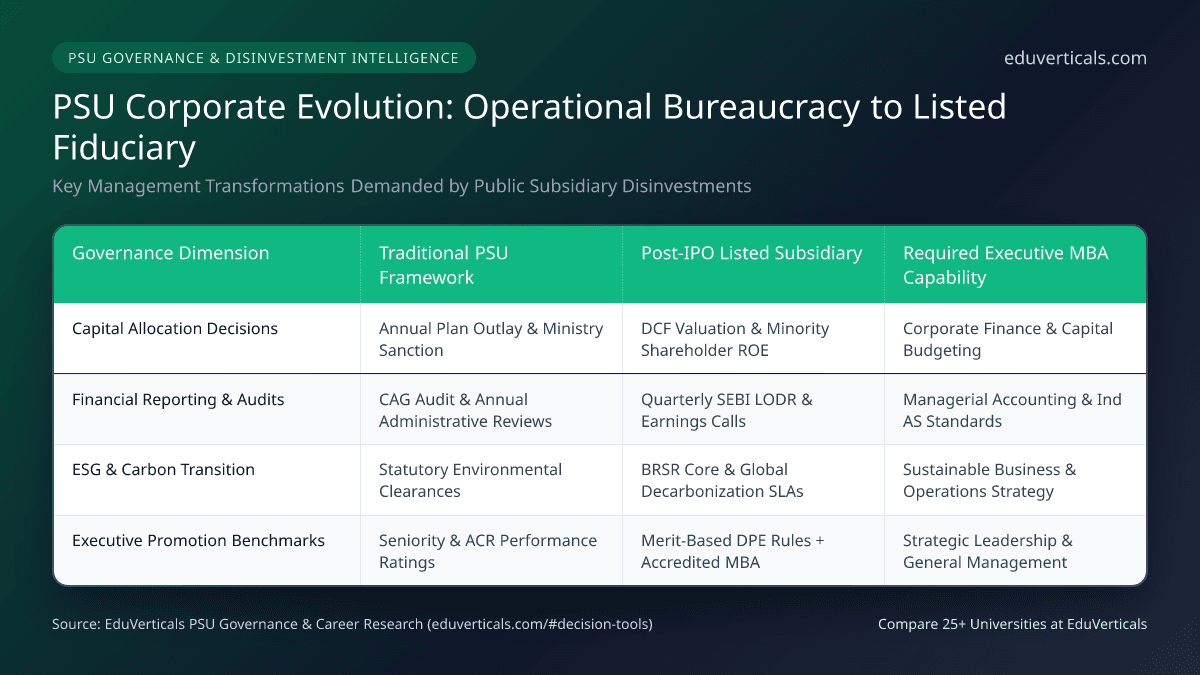
In a non-listed public enterprise, capital expenditure follows traditional bureaucratic sanction channels: five-year plan outlays, board approvals, and government ministry clearances. The primary operational objective is volumetric production—delivering designated metric tonnes of coal to pithead thermal power plants to satisfy national grid demand.
In a listed corporate environment, volumetric output alone is insufficient. Institutional equity analysts and asset management funds scrutinize quarterly EBITDA margins, Free Cash Flow conversion, Working Capital days, and Return on Capital Employed (ROCE). A mine general manager can no longer simply be an exceptional mining engineer; they must function as an astute P&L business leader capable of defending capital allocation decisions during public investor conferences.
Select your career goal to tailor advice
Enroll in an AICTE and UGC-DEB recognized Online MBA to fulfill mandatory educational criteria for senior scale promotions.
Department of Public Enterprises (DPE) guidelines and Maharatna/Navratna executive appraisal scorecards (Annual Confidential Reports and Performance-Linked Incentive frameworks) have evolved dramatically. Across entities like Coal India, NTPC, ONGC, SAIL, and BHEL, promotions from technical managerial tiers (E3/E4) to senior executive cadres (E5/E6/E7—Chief General Manager, Executive Director, and Board Functional Director) place heavy weight on formal business qualifications.
A brilliant mechanical or electrical engineer who spent twelve years managing field extraction inevitably reaches an administrative glass ceiling unless they master modern business competencies: corporate law, supply chain optimization, industrial relations, and ESG reporting. This institutional requirement has catalyzed an unprecedented rush among public sector officers to acquire accredited management degrees.
Public sector executives face a strict regulatory constraint: government service conduct rules prevent full-time study leaves without complex ministry sanctions and service bonds. Consequently, UGC-DEB entitled Online and Distance MBAs represent the sole legally compliant route for in-service upskilling.
Programmes offered by central institutions such as the IGNOU Online MBA or state-recognized universities with NAAC A++ accreditation like Manipal University Jaipur provide recognized postgraduate credentials that fully comply with central government promotion circulars. For technical managers seeking advanced analytical depth, institutions like IIT Patna Online offer cutting-edge executive curricula blending management with digital technologies.
Explore verified public sector-friendly degree pathways on the Course Catalog and compare fee structures on EduVerticals University Compare. Receive a tailored shortlist from our admission partners to match your departmental promotion criteria.
Keep the details close
Explore key programme specifications, recognition terms, fee components, and career outcomes side by side before applying.
Yes. As long as the degree is awarded by an institution recognized by the University Grants Commission (UGC) and the Distance Education Bureau (DEB), it carries complete statutory equivalence to a regular on-campus degree for CPSE/PSU promotions, scale increments, and departmental exams.
Bring programme options, estimated fees and study flexibility into one view, with the trade-offs and questions to verify.
Tailored shortlist from our admission partners. Verify fees and eligibility before applying.


We have a team of over 12 experienced mentors with over 26+ years of collective experience available to guide you at a moment's notice.