 EduVerticals Editorials
Posted 1 day ago

Executive SummaryReading BriefExecutive Summary: With CAT 2026 registrations crossing 3.3 lakh aspirants competing for approximately 5,500 seats across old and new IIMs, the acceptance rate for flagship programs hovers below 1.7%. For working professionals earning ₹12L–₹22L CTC, quitting a corporate role entails a staggering opportunity cost of ₹24L–₹44L in lost compensation plus ₹28L in campus debt. A rigorous financial audit reveals why accredited UGC-DEB Online MBAs from top-tier universities deliver superior risk-adjusted return on investment (ROI) for professionals with over three years of corporate tenure.
Every November, India’s corporate offices witness a familiar silent drama: thousands of software engineers, financial analysts, and marketing specialists spend late nights solving quantitative aptitude mock tests and data interpretation sets. The dream of cracking the Common Admission Test (CAT) and walking through the red-brick gates of Ahmedabad, Bangalore, or Calcutta remains deeply ingrained in the Indian middle-class ethos. Yet in late 2026, the underlying economics of this pursuit have fundamentally shifted.
When CAT candidate numbers cross 3.3 lakh while total general-category seats in top-10 institutions remain virtually static, the statistical reality becomes unforgiving. Over 98% of test-takers—regardless of their intelligence or months of preparation—will not secure an admission offer from a premier institute. For fresh college graduates with zero salary, taking a year to prepare or joining a tier-2 residential b-school carries manageable financial friction. But for an experienced executive, quitting a salaried role introduces a massive, often uncalculated financial hemorrhage: the balance sheet opportunity cost.
Consider the structural funnel of CAT 2026. While headlines celebrate record registrations, the institutional capacity of India’s top management institutes tells a sober story. Across all 21 IIMs, total postgraduate program intake stands near 5,500 seats. However, after accounting for constitutional reservations, gender diversity weightages, and academic stream normalization, the open general merit pool in the coveted BLACKI cohort (Bangalore, Lucknow, Ahmedabad, Calcutta, Kozhikode, Indore) offers fewer than 1,800 seats.
This creates an hyper-competitive threshold where even a 99.2 percentile score fails to guarantee an interview shortlist for male engineering applicants with standard profiles. Thousands of talented professionals spend two to three years caught in a "repeat-and-retake" loop, sacrificing vital corporate momentum, appraisal cycles, and career seniority while pursuing marginal percentile gains.
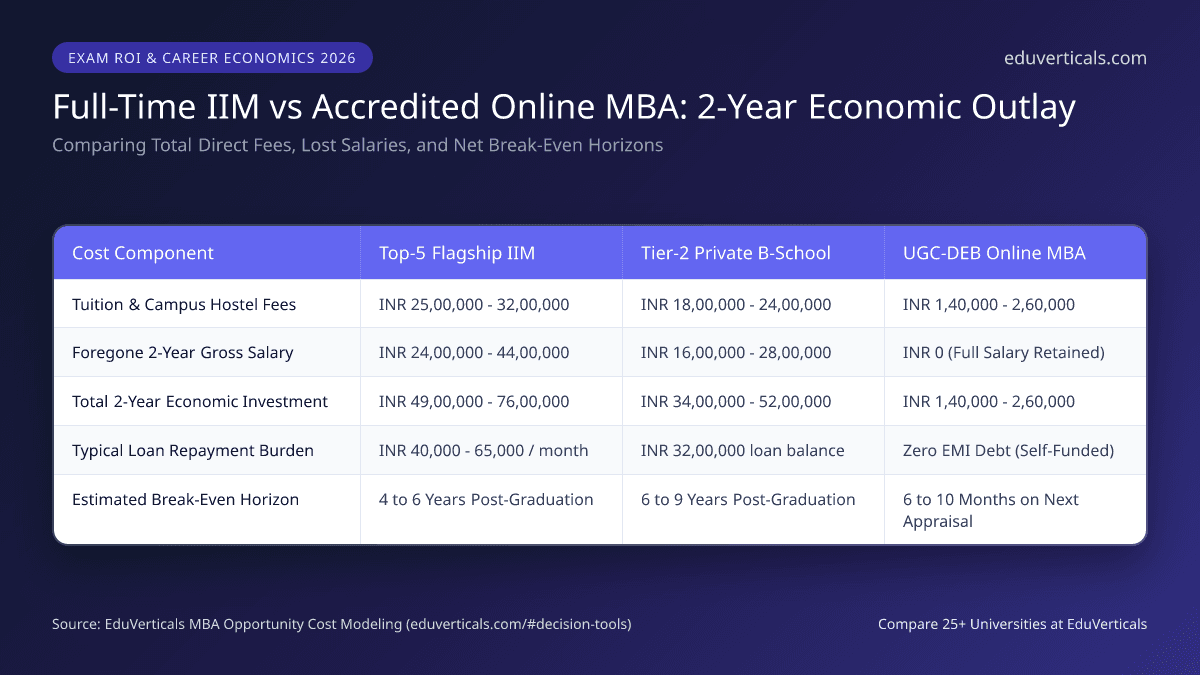
When business schools advertise average domestic placement packages of ₹28L–₹34L, prospective candidates often mistake gross CTC for net personal wealth creation. The true economic cost of a full-time, two-year residential degree consists of two distinct components: direct capital expenditure and foregone operating cash flows.
Does a residential MBA still make sense? Absolutely—provided you fall into specific demographic and career segments. If you are under 24 years old, possess under two years of experience, and aspire to enter bulge-bracket investment banking front-offices, sovereign wealth advisory, or elite management consulting partnerships (McKinsey, BCG, Bain), the flagship campus placement pipeline remains the undisputed gateway.
However, for the vast majority of corporate roles—including product management, corporate finance, enterprise sales, operational logistics, and human capital leadership—hiring managers prioritize demonstrated industry execution over campus pedigree. If your goal is transitioning from a Team Lead to an Assistant Vice President or General Manager within your existing industry, surrendering ₹35L in salary to obtain a campus degree is an inefficient capital allocation strategy.
Select your career goal to tailor advice
Recommended only if you are under 24 with under 2 years of corporate experience and target front-office investment banking or top-tier strategy consulting.
Recognizing this financial asymmetry, tens of thousands of experienced professionals are adopting an alternative path: securing an accredited, UGC-DEB entitled Master of Business Administration while remaining fully employed. Top-tier institutions such as NMIMS CDOE, Symbiosis Centre for Distance and Online Learning (SSODL), and Manipal University Jaipur (MUJ) deliver comprehensive postgraduate curricula covering financial accounting, strategic management, digital marketing, and operations analytics.
The mathematical divergence is striking. An accredited Online MBA typically costs between ₹1,40,000 and ₹2,60,000 over two years. Because lectures are delivered live on weekends or via asynchronous LMS portals, your corporate salary continues uninterrupted. Furthermore, the knowledge acquired in classes—such as capital budgeting or customer lifetime value modeling—can be applied immediately to your active corporate projects, driving faster promotions during annual appraisal cycles.
Before committing to an exam retake or taking on crippling debt, use and compare approved curricula on the Academic Catalog to calculate your personal five-year earnings trajectory. Request a tailored shortlist from our admission partners to discover programs that match your work schedule and budget.
Keep the details close
Explore key programme specifications, recognition terms, fee components, and career outcomes side by side before applying.
Yes. As per University Grants Commission (UGC) regulations, degrees awarded through Open and Distance Learning (ODL) and Online modes by UGC-DEB entitled universities are treated as equivalent to traditional on-campus degrees for employment and promotion purposes across private enterprises, multinational corporations, and public sector undertakings.
Bring programme options, estimated fees and study flexibility into one view, with the trade-offs and questions to verify.
Tailored shortlist from our admission partners. Verify fees and eligibility before applying.


We have a team of over 12 experienced mentors with over 26+ years of collective experience available to guide you at a moment's notice.