 EduVerticals Editorials
Posted 3 months ago
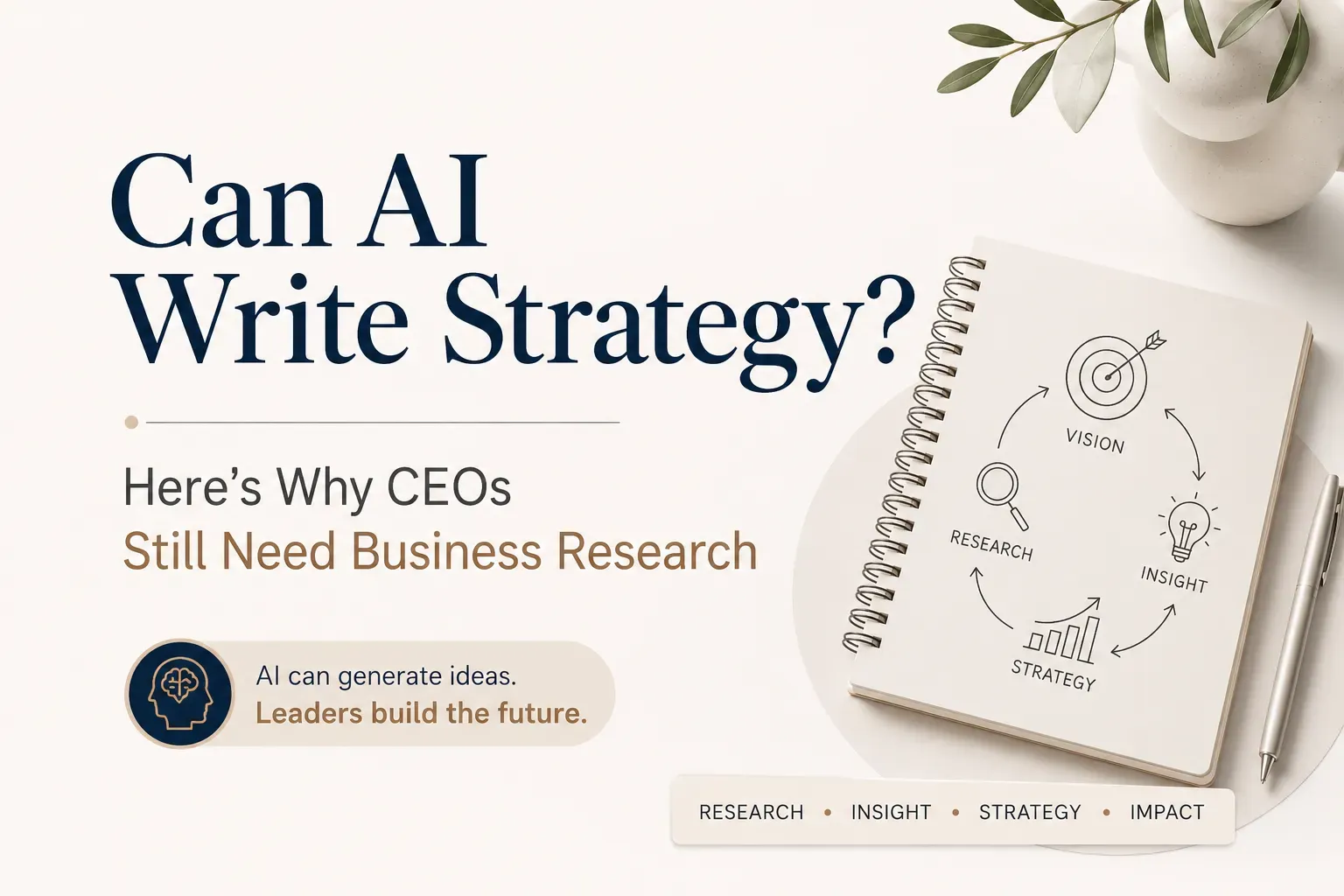
Artificial Intelligence has transformed the way businesses operate. From generating reports and analyzing customer data to creating presentations and forecasting trends, AI has become an indispensable business tool. Yet one question continues to spark debate in boardrooms around the world:
The answer is both yes and no.
AI can certainly support strategic planning by processing enormous amounts of information in seconds. However, when it comes to making high-stakes business decisions, balancing competing priorities, understanding human behavior, and navigating uncertainty, business research and human judgment remain irreplaceable.
As organizations adopt AI at an unprecedented pace, CEOs are discovering that competitive advantage no longer comes from simply using AI—it comes from knowing how to use AI wisely.
Modern AI tools can summarize market reports, identify patterns, and even recommend business actions based on historical data.
For example, AI can:
- Analyze customer behavior.
- Forecast sales trends.
- Identify operational inefficiencies.
- Generate SWOT analyses.
- Recommend pricing strategies.
- Summarize competitor activities.
These capabilities save businesses significant time and improve productivity.
However, strategy involves much more than data analysis.
Business strategy requires leaders to answer questions that have no perfect or historical answer.
Should a company enter a new market?
Should it acquire a competitor?
Should it invest in emerging technology despite uncertain returns?
These decisions involve risk, ethics, organizational culture, stakeholder expectations, and long-term vision—areas where human judgment remains essential.
AI learns from existing information. Great business leaders create new possibilities.
History's most successful companies often succeeded by making decisions that historical data could not predict.
Innovation rarely follows established patterns.
This is why CEOs still rely on critical thinking, experience, and research rather than blindly following AI-generated recommendations.
AI can provide options.
Leaders choose the direction.
The explosion of AI-generated content has made reliable business research increasingly valuable.
Business research helps organizations:
- Validate assumptions.
- Understand customer behavior.
- Evaluate market opportunities.
- Measure business risks.
- Test strategic decisions.
- Build evidence-based strategies.
Instead of accepting the first AI-generated answer, successful leaders ask deeper questions, challenge assumptions, and seek reliable evidence before making major decisions.
Research transforms information into informed decision-making.
Today's executives are expected to justify decisions with facts rather than intuition alone.
Evidence-based leadership combines:
- Business research.
- Market intelligence.
- Financial analysis.
- Customer insights.
- Organizational data.
- Professional experience.
AI contributes to this process by accelerating analysis.
However, leaders remain responsible for interpreting results and making final decisions.
This combination of AI and human expertise is becoming the new standard for executive leadership.
As businesses become increasingly data-driven, many senior professionals are pursuing a Doctorate in Business Administration (DBA).
Unlike traditional academic research, a DBA focuses on solving real-world business challenges through applied research.
A DBA helps professionals:
- Conduct strategic business research.
- Solve complex organizational problems.
- Improve executive decision-making.
- Develop evidence-based leadership.
- Strengthen consulting capabilities.
- Build credibility in senior leadership roles.
Rather than relying solely on intuition, DBA graduates learn how to support business decisions with structured research and practical evidence.
While a DBA emphasizes applied research, an Executive MBA focuses on transforming research into business action.
Executive MBA programs prepare experienced professionals to:
- Develop competitive strategies.
- Lead digital transformation.
- Manage organizational change.
- Evaluate financial performance.
- Build high-performing teams.
- Make strategic decisions under uncertainty.
Many modern Executive MBA programs also include AI, business analytics, innovation management, and digital leadership, ensuring graduates can combine technology with sound managerial judgment.
Not every professional needs a doctorate.
For aspiring managers and mid-career professionals, an Online MBA offers a flexible way to develop strategic thinking while continuing full-time employment.
Today's Online MBA programs emphasize:
- Strategic management.
- Business analytics.
- Marketing.
- Finance.
- Operations.
- Leadership.
- Digital business.
- AI applications in management.
Graduates develop the ability to interpret business information instead of simply consuming it.
Future business leaders will not compete based on who uses AI.
They will compete based on who asks better questions.
Successful CEOs will combine:
- Critical thinking.
- Business research.
- Strategic leadership.
- Emotional intelligence.
- Ethical decision-making.
- Innovation.
- Data literacy.
- AI capabilities.
Technology can improve efficiency.
Leadership creates direction.
Employers increasingly value professionals who can:
- Interpret complex business data.
- Solve strategic problems.
- Evaluate business risks.
- Lead AI adoption responsibly.
- Make evidence-based decisions.
- Drive organizational transformation.
These are precisely the capabilities developed through Executive MBA, Online MBA, and DBA programs.
If your career goal is to become a senior manager, consultant, entrepreneur, or executive leader, understanding business research is becoming a significant competitive advantage.
A DBA is ideal for professionals who want to solve organizational problems through research.
An Executive MBA prepares experienced managers for strategic leadership.
An Online MBA builds management skills for professionals seeking career advancement while maintaining flexibility.
Each pathway develops different strengths, but all emphasize the importance of analytical thinking, informed decision-making, and leadership in an AI-driven business environment.
Artificial Intelligence is changing how businesses gather information, analyze data, and automate routine tasks. However, strategy remains fundamentally human.
The leaders who will shape the future are not those who rely entirely on AI, but those who combine technology with critical thinking, business research, and strategic judgment.
Whether you're considering an Online MBA, an Executive MBA, or a DBA, one thing is becoming increasingly clear: the future belongs to professionals who can transform information into insight and insight into action.
AI can help write reports.
It can even suggest strategies.
But building a business that thrives for decades still requires leaders who understand people, ask meaningful questions, and make decisions grounded in research.
Can AI create a business strategy?
AI can generate strategic recommendations based on data, but it cannot fully replace human judgment, leadership, creativity, and contextual decision-making.
Why is business research important in the AI era?
Business research helps leaders validate information, reduce risk, understand markets, and make evidence-based decisions rather than relying solely on AI-generated outputs.
Is a DBA useful for senior executives?
Yes. A DBA develops advanced research and strategic problem-solving skills that help executives make informed business decisions and address complex organizational challenges.
Should I choose an Executive MBA or a DBA?
An Executive MBA is best for experienced professionals seeking leadership and management advancement, while a DBA is ideal for executives who want to solve business problems through applied research.
Can an Online MBA prepare me for AI-driven businesses?
Yes. Many Online MBA programs now include business analytics, digital transformation, AI applications, and strategic management, equipping graduates for leadership in technology-driven organizations.


We have a team of over 12 experienced mentors with over 26+ years of collective experience available to guide you at a moment's notice.