 EduVerticals Editorials
Posted 4 months ago
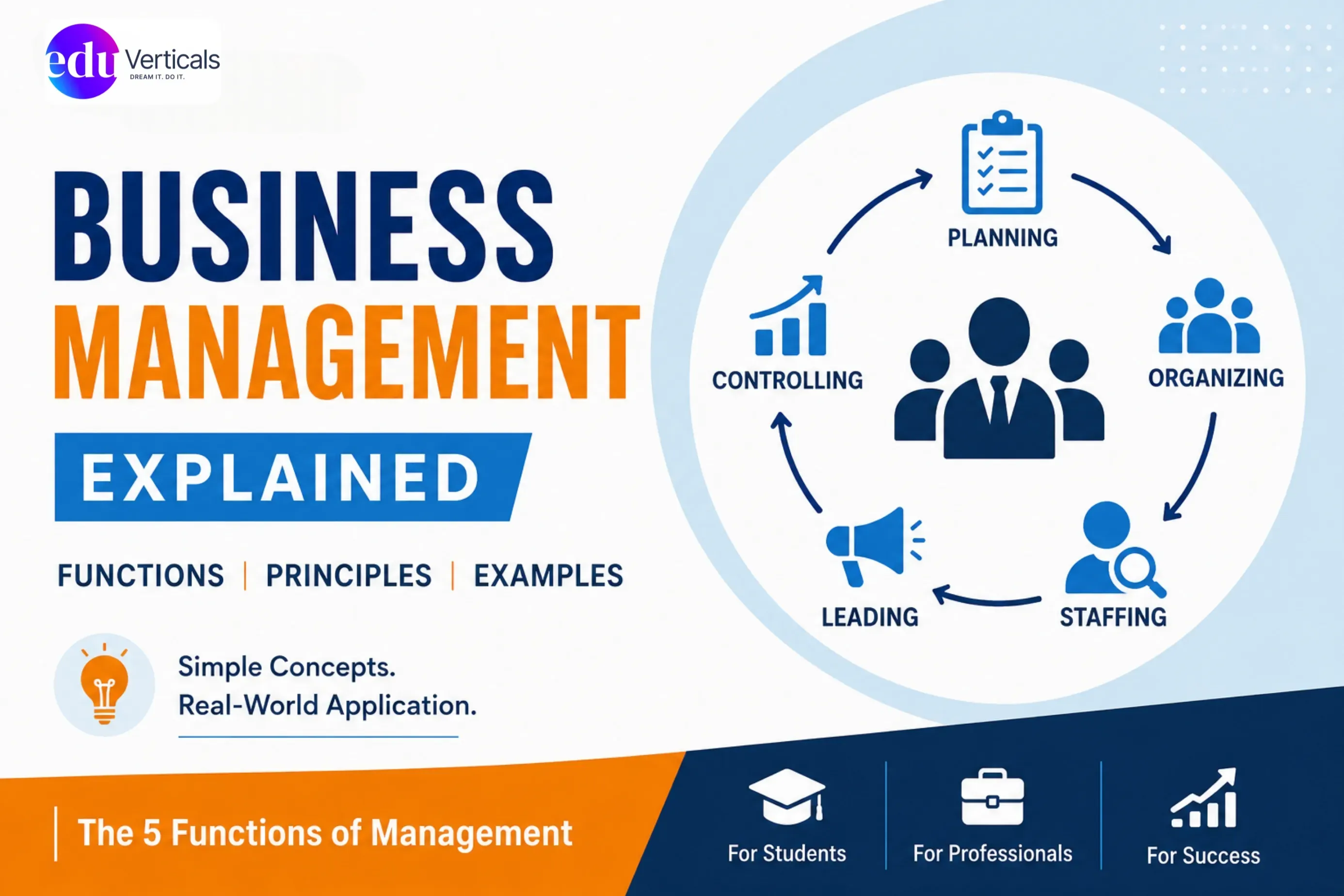
Behind every successful company is effective business management.
Whether it's a startup disrupting an industry, a multinational corporation managing global operations, or a family-run enterprise expanding into new markets, business management serves as the foundation that drives organizational success.
In today's competitive environment, organizations need managers who can make informed decisions, lead diverse teams, allocate resources efficiently, and adapt to rapid technological changes. This is why business management remains one of the most important disciplines in the modern business world.
In this comprehensive guide, you'll learn what business management is, its core functions, key principles, real-world examples, career opportunities, and why mastering management skills is essential for future leaders.
Business management refers to the process of planning, organizing, directing, and controlling an organization's resources to achieve specific goals efficiently and effectively.
These resources may include:
Simply put, business management is the practice of coordinating people and resources to achieve organizational objectives while maximizing productivity and profitability.
Every organization, regardless of size or industry, relies on management to maintain operations, solve problems, improve performance, and achieve sustainable growth.
Without proper management, even organizations with excellent products and services can struggle to survive.
Business management helps organizations:
Strong management ensures that all departments work toward a common goal rather than operating in isolation.
The scope of business management extends across every area of an organization.
Managers are involved in:
Developing long-term goals and growth plans.
Ensuring smooth day-to-day business activities.
Recruiting, developing, and retaining talent.
Managing budgets, investments, and financial performance.
Planning and executing strategies to attract and retain customers.
Managing specific initiatives within defined timelines and budgets.
As businesses become increasingly complex, management plays a crucial role in coordinating these functions effectively.
One of the most widely accepted frameworks in management theory identifies five primary functions of business management.
These functions form the foundation of managerial activities in every organization.
Planning is the process of determining organizational goals and deciding how to achieve them.
It serves as the starting point for all management activities.
A university planning to launch a new Online MBA program must analyze market demand, competitor offerings, tuition pricing, and expected enrollment before implementation.
Effective planning reduces uncertainty and helps organizations prepare for future challenges.
Once plans are developed, managers must organize resources to implement them effectively.
Organizing involves creating structures that enable people to work efficiently toward common objectives.
A digital marketing company may establish separate teams for:
This structure improves accountability and productivity.
Staffing focuses on ensuring the organization has the right people in the right positions.
People remain one of the most valuable assets in any business.
A technology startup developing AI solutions may recruit:
The quality of talent often determines the success of an organization.
Organizations with skilled employees are more innovative, productive, and adaptable.
Directing, often called leading, involves motivating employees and guiding them toward organizational goals.
Leadership is the function that transforms plans into action.
During a major product launch, managers coordinate multiple departments while keeping teams motivated and focused on deadlines.
Strong leaders create environments where employees can perform at their best.
Controlling ensures that actual performance aligns with planned objectives.
Managers continuously monitor outcomes and make adjustments when necessary.
A company sets a monthly sales target of ₹50 lakh. If actual sales reach only ₹40 lakh, management investigates the causes and implements corrective measures.
Without control mechanisms, organizations may drift away from their goals and waste valuable resources.
The principles of business management provide guidelines for effective organizational leadership and decision-making.
Many of these principles were developed by the French management theorist Henri Fayol, whose ideas continue to influence modern management practices.
Specialization increases efficiency and improves productivity.
Employees perform better when they focus on specific responsibilities.
Managers must possess sufficient authority to fulfill their responsibilities while remaining accountable for results.
Organizations function effectively when employees follow established rules, procedures, and standards.
Employees should receive instructions from only one supervisor to avoid confusion and conflict.
All activities with similar objectives should operate under a single plan and leadership structure.
Managers should treat employees fairly and respectfully to maintain motivation and trust.
Organizations should encourage employees to contribute ideas and participate in problem-solving.
Reducing unnecessary employee turnover supports long-term organizational performance.
Strong teamwork enhances collaboration, morale, and organizational success.
Successful managers require both technical and interpersonal skills.
Leadership Skills
Ability to inspire and guide teams.
Communication Skills
Clear communication improves coordination and reduces misunderstandings.
Decision-Making Skills
Managers must evaluate information and choose appropriate actions.
Problem-Solving Skills
Every organization faces challenges that require analytical thinking.
Time Management Skills
Effective managers prioritize tasks and maximize productivity.
Strategic Thinking
Long-term success depends on anticipating opportunities and risks.
Emotional Intelligence
Understanding and managing emotions improves workplace relationships and leadership effectiveness.
Digital Literacy
Modern managers increasingly rely on technology, analytics, and AI-driven tools.
Business management knowledge opens doors to diverse career paths across industries.
Popular career options include:
Professionals with management expertise often advance into leadership positions and enjoy strong career growth opportunities.
The role of business management is evolving rapidly.
Organizations today face challenges such as:
Modern managers must combine traditional management principles with technological understanding to remain effective.
Those who can manage people, processes, and technology simultaneously will be among the most valuable professionals in the future workforce.
Business management is the backbone of every successful organization. By mastering the functions of planning, organizing, staffing, directing, and controlling, businesses can improve efficiency, achieve strategic goals, and create sustainable growth.
Whether you are a student considering an MBA, a working professional aiming for leadership roles, or an entrepreneur building a company, understanding business management provides a strong foundation for long-term success.
In a world shaped by innovation, competition, and digital transformation, effective business management remains one of the most important drivers of organizational excellence.
What is business management in simple words?
Business management is the process of planning, organizing, leading, and controlling resources to achieve organizational goals efficiently.
What are the five functions of business management?
The five core functions are:
Why is business management important?
Business management helps organizations improve productivity, optimize resources, achieve goals, and remain competitive.
What are the principles of business management?
Key principles include division of work, authority and responsibility, discipline, unity of command, unity of direction, equity, initiative, and teamwork.
Is business management a good career?
Yes. Business management offers opportunities across industries in leadership, operations, marketing, human resources, consulting, and entrepreneurship.


We have a team of over 12 experienced mentors with over 26+ years of collective experience available to guide you at a moment's notice.