 EduVerticals Editorials
Posted 1 day ago
Executive SummaryReading BriefExecutive Summary: Global energy markets in late 2026 present a striking paradox. Geopolitical friction in the Middle East and maritime transit bottlenecks in the Red Sea and Strait of Malacca pushed Brent crude above $96 per barrel in sudden speculative surges. Yet simultaneously, the International Energy Agency (IEA) and commodity economists forecast a structural oil supply surplus exceeding 1.2 million barrels per day heading into 2027, driven by non-OPEC+ production expansions in the Americas and slowing global demand growth. For Indian enterprise supply chains—where logistics and energy account for over 13% of domestic GDP—this severe volatility threatens operating margins. Corporate boards are actively dismantling static annual freight procurement contracts in favor of quantitative fuel indexing, multimodal rail shifts via the Dedicated Freight Corridor (DFC), and advanced procurement analytics.
Energy is the universal raw material of physical commerce. When Brent crude fluctuates by 25% within a single quarter, the shockwaves reverberate across every link of the Indian enterprise economy: from diesel-powered long-haul road transportation fleets and petrochemical packaging polymer resins (polypropylene and polyethylene) to maritime ocean freight bunker adjustment factors (BAF). For corporate executives, crude volatility is not merely a macroeconomic statistic—it is an immediate threat to gross margins. In late 2026, an unhedged procurement contract can transform a projected 14% operating margin into a severe net loss before the first finished consignment reaches customer loading docks.
Consequently, Indian manufacturing giants, FMCG distributors, and e-commerce logistics operators are overhauling their supply chain leadership teams. Chief Supply Chain Officers (CSCOs) are replacing traditional purchasing agents with quantitatively trained procurement analysts and operations managers capable of designing dynamic pricing matrices, commodity hedging collars, and multimodal logistics models.
Navigating energy cost structures in late 2026 requires understanding the conflicting forces driving global commodity desks. On one hand, geopolitical risk premiums and maritime choke points create sharp, short-term upward price spikes. On the other hand, long-term macroeconomic supply fundamentals point toward softening energy prices.
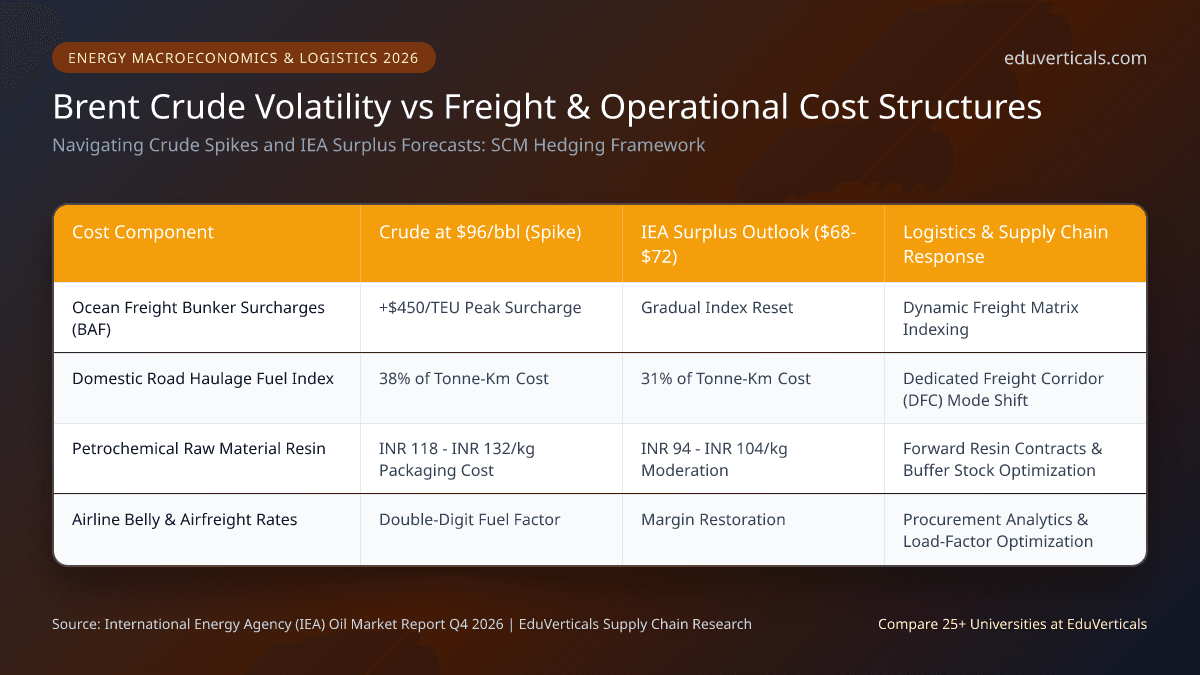
To neutralize crude oil whipsaws, sophisticated supply chain directors are deploying multi-tiered operational playbooks that insulate corporate balance sheets from spot market shocks. The era of the static, handshake vendor agreement has officially ended.
One of the most powerful structural defenses is modal optimization: shifting long-haul freight from road transportation to Indian Railways’ Dedicated Freight Corridors (Western and Eastern DFCs). Electrified rail freight produces zero direct diesel exposure, lowers transportation costs per tonne-kilometer by 28% to 35%, and cuts transit times between industrial manufacturing hubs in Haryana/Rajasthan and western ports in Gujarat and Maharashtra by more than half.
Select your career goal to tailor advice
Specialize in multimodal logistics modeling and route optimization. Compare options in our University Comparison Report or book a Free Mentor Call.
The modern supply chain leader is not a warehouse dispatcher; they are a financial strategist and mathematical optimizer. Enterprises are aggressively offering ₹35 LPA to ₹65 LPA compensation packages for Supply Chain VPs, Procurement Directors, and Logistics Strategy Heads who can protect operating margins against macro shocks.
Working logistics professionals, warehouse managers, and mechanical engineers are acquiring these high-value capabilities through UGC-DEB entitled Online MBAs in Operations and Supply Chain Management. Premier institutions such as Manipal University Jaipur (MUJ) provide comprehensive curricula covering quantitative supply chain modeling, enterprise procurement law, predictive analytics, and corporate finance.
Because these programs feature flexible online delivery and real-world case simulations, professionals can master complex contract indexing and working capital frameworks while maintaining their full-time corporate responsibilities. To evaluate accredited logistics management degrees, explore the EduVerticals Academic Catalog or compare specialization options in our EduVerticals Course Catalog.
Decision NoteReading BriefUpgrade Your Operational & Supply Chain Career: Benchmark accredited Operations and Logistics MBA degrees across top Indian universities using .
Keep the details close
Explore key programme specifications, recognition terms, fee components, and career outcomes side by side before applying.
Crude swings directly impact logistics through ocean freight bunker surcharges (BAF), road transportation diesel tariffs, and petrochemical packaging materials (polymers and resins). A 20% spike in oil prices can increase total corporate logistics expenses by 6% to 9%.
Bring programme options, estimated fees and study flexibility into one view, with the trade-offs and questions to verify.
Tailored shortlist from our admission partners. Verify fees and eligibility before applying.


We have a team of over 12 experienced mentors with over 26+ years of collective experience available to guide you at a moment's notice.