
logo

Android XR & Smart Glasses: Wearable Product Management Strategy (2026)

Android XRAI Smart GlassesWearable Product ManagementSpatial Computing StrategyGoogle Samsung XR 2026Online MBA Product ManagementEduVerticals
EduVerticals EditorialsEduVerticals Editorials

Posted 1 day ago

Android XR & Smart Glasses: Wearable Product Management Strategy (2026)
Executive Summary
Reading Brief
Executive Summary: The late-2026 commercial release of Google and Samsung’s Android XR platform, paired with fashionable sub-60-gram AI smart glasses, officially marked the post-smartphone inflection point. For over a decade, spatial computing was trapped in the heavy, niche ghetto of virtual reality gaming headsets. Android XR broke that barrier by merging diffraction waveguide optics, all-day battery efficiency, and continuous multimodal computer vision into prescription-ready eyewear. This commercial breakthrough has ignited intense corporate demand for a rare breed of technology leader: Wearable Product Managers who can master the delicate intersection of hardware Bill of Materials (BOM) constraints, consumer D2C unit economics, and recurring spatial software subscription revenue.

Unlike traditional web or mobile software product management—where features can be iterated and deployed to production continuously with near-zero marginal cost—wearable spatial computing operates under severe physical constraints. A product lead managing an Android XR device must balance milliwatt thermal dissipation limits, weight distribution across the nasal bridge, optical transparency in bright Indian sunlight, and complex multi-tier supply chains spanning Taiwan, South Korea, and Indian assembly corridors.

Simultaneously, the commercial monetization of smart glasses demands sophisticated business modeling. Selling hardware alone at a 30% gross margin is insufficient to support billions in continuous cloud AI inference, spatial mapping updates, and real-time audio translation. As Indian tech conglomerates and consumer brands launch localized XR hardware and B2B enterprise field applications, Product Managers are expected to manage complete P&L lifecycles spanning hardware procurement, developer app store economics, and monthly recurring software subscriptions.

1. The Architecture of Spatial Computing: Why Android XR Won the Form-Factor Battle

The triumph of Android XR smart glasses over legacy spatial headsets rests on four distinct engineering and product breakthroughs commercialized in 2026:
  • Waveguide Optics and MicroLED Luminance: Advanced surface-relief diffraction gratings allow high-contrast, full-color heads-up displays to project crisp text and directional navigation directly onto transparent lenses without obstructing natural eye contact.
  • Split-Compute Architecture: By offloading heavy computer vision rendering and multi-billion-parameter multimodal reasoning to a tethered smartphone puck or localized edge cloud, the glasses maintain an ultra-light form factor under 55 grams.
  • Micro-Gesture and Gaze Interaction: Subtle wrist-worn EMG sensors and inward-facing corneal tracking cameras eliminate the need for awkward mid-air hand-waving, enabling discreet, socially acceptable input in crowded public spaces.
  • Contextual Multimodal Intelligence: Continuously active microphones and outward-facing low-power cameras allow on-device Small Language Models (SLMs) to perceive what the user sees and hears, delivering real-time translation, facial recall, and step-by-step diagnostic overlays.
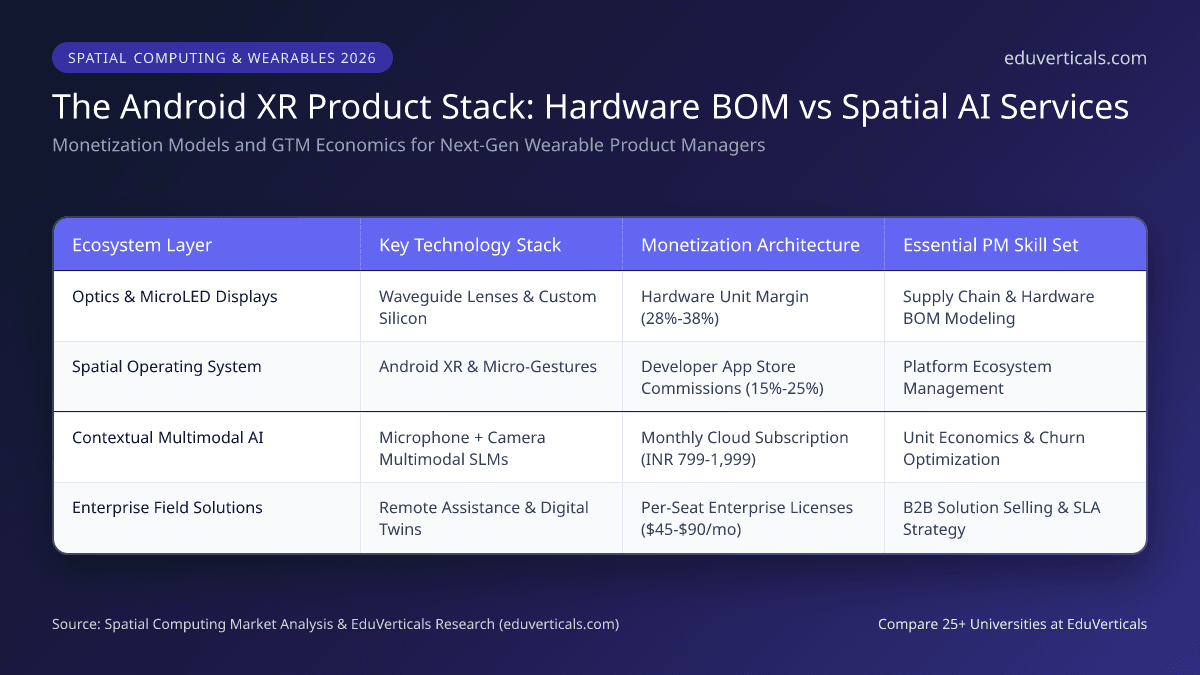
Android XR Product Stack Hardware BOM vs Spatial AI Services 2026
Android XR Wearable Product Stack: Comparing Hardware BOM Economics and Recurring Spatial AI Services.

2. Commercializing Wearables: The Dual-Monetization Engine

For technology leaders in Indian consumer tech and multinational GCCs, managing an XR product line requires balancing two radically different economic models:

  1. Upfront Hardware Gross Margin (28%–38%): Managing yield rates for custom waveguide glass and micro-sensors, while pricing consumer smart glasses within India’s aspirational electronics sweet spot (₹24,999 to ₹49,999).
  2. Recurring Cloud Spatial Subscriptions (₹799–₹1,999/month): Monetizing real-time voice translation, unlimited cloud contextual memory, and high-definition generative scene synthesis as an ongoing value-added service.
  3. Enterprise B2B Field Service Licenses ($45–$90/seat/month): Packaging ruggedized Android XR headsets for manufacturing plant inspections, automotive assembly lines, and remote surgical consultations across Indian industrial corridors.
  4. App Store & Ecosystem Commissions: Establishing developer revenue splits (15% to 25%) for third-party spatial gaming, productivity tools, and interactive educational content.
Interactive Career Pulse

Select your career goal to tailor advice

Decision note · Verified comparison01 / 03

Where do you see your product management career evolving over the next 3 to 5 years?

Mentor RecommendationTraditional Web/Mobile SaaS

Expand your competencies into multimodal user journeys and hardware-software integration. Use our University Comparison Report to explore advanced product management specializations.

Tailored shortlist from our admission partners

3. How Product Managers Can Prepare for the Spatial Era

The shift toward spatial computing is creating an acute shortage of senior product leadership. Companies are offering packages ranging from ₹45 LPA to ₹80 LPA + ESOPs for Principal Product Managers and VP of Hardware Products who can navigate physical supply chains, negotiate telecommunications carrier partnerships, and manage recurring software churn.

To make this transition, software professionals are pairing their technical depth with the NMIMS CDOE Online MBA in Business Analytics & Product Strategy, which provides the comprehensive grounding in supply chain logistics, customer lifetime value modeling, pricing strategy, and brand positioning required to launch market-defining products.

  • Master End-to-End P&L Leadership: Go beyond user story backlogs to own physical inventory risks, manufacturing warranty reserves, and net recurring software margins.
  • Explore Accredited University Portfolios: Inspect comprehensive curriculum comparisons on the EduVerticals Academic Catalog to identify leading management programs.
  • Explore Specialized Degree Options: Review competitive specialization offerings on the EduVerticals Course Catalog to find programs that match your exact career goals.
  • Model Your Long-Term ROI: Evaluate how an accredited executive degree impacts your five-year salary progression via .

Keep the details close

Common QuestionsThe full picture.

Explore key programme specifications, recognition terms, fee components, and career outcomes side by side before applying.

05 verified FAQs

Android XR is Google and Samsung’s open operating system designed specifically for lightweight, transparent smart glasses and spatial eyewear, focusing on all-day ambient productivity and multimodal AI rather than bulky immersive gaming.

01 / The Facts, Side by Side
Live Comparison Dossier

University Comparison Report

Bring programme options, estimated fees and study flexibility into one view, with the trade-offs and questions to verify.

01Fee Structure
02Study Mode
03Career Fit

Tailored shortlist from our admission partners. Verify fees and eligibility before applying.

Meet Our Mentors

We have a team of over 12 experienced mentors with over 26+ years of collective experience available to guide you at a moment's notice.

Got Questions?

Online and distance learning programs provide: - Flexibility to learn at your own pace from anywhere. - Access to recorded lectures and digital study materials. - Opportunities to balance work, education, and personal commitments. - Affordable options compared to traditional on-campus programs. - Industry-relevant curriculum designed by academic experts.
Choosing the right university depends on: - Accreditation and recognition of the institution. - Quality and relevance of the curriculum. - Availability of academic and career support services. - Feedback and reviews from alumni and current students. - Flexibility in learning schedules and delivery modes.
Yes, online degrees from accredited universities are widely recognized and equivalent to regular degrees. Employers value the skills and qualifications gained from online programs, especially when offered by reputed institutions.
Assessment methods for online programs vary but typically include: - Online quizzes and assignments. - Virtual proctored exams. - Group projects and case studies. - Real-time presentations and viva sessions.
Many universities allow credit transfers, subject to: - Compatibility with the curriculum of the new program. - A minimum grade requirement in previously completed courses. - Approval by the academic administration of the new university.