
logo

Ambient IoT & Smart Home in India: Hardware-Plus-SaaS Subscription Economics (2026)

Ambient IoT India 2026Smart Home Hardware SaaSHardware Subscription EconomicsRecurring Revenue IndiaConnected Devices MBAProduct Operations LeadershipEduVerticals
EduVerticals EditorialsEduVerticals Editorials

Posted 1 day ago

Ambient IoT & Smart Home in India: Hardware-Plus-SaaS Subscription Economics (2026)
Executive Summary
Reading Brief
Executive Summary: The rapid adoption of smart security cameras, air quality hubs, robotic vacuum cleaners, and ambient sensor arrays across urban Indian households in late 2026 has exposed a fundamental business model crisis for hardware manufacturers. Standalone smart devices face brutal margin erosion: aggressive e-commerce discounting, rising silicon component costs, and steep marketplace commissions drive hardware gross margins down to an unsustainable 12% to 18%. To survive and scale, Indian IoT enterprises are pivoting to hardware-plus-SaaS bundling. By selling hardware near bill-of-materials cost and attaching recurring cloud subscriptions—such as AI video anomaly detection, automated energy optimization, and continuous device warranty coverage via UPI AutoPay—smart home startups are building predictable Annual Recurring Revenue (ARR) engines that multiply Customer Lifetime Value (LTV) by up to 3.8 times.

For decades, consumer electronics manufacturing in India operated under a simple transactional model: import sub-assemblies or white-labeled hardware from East Asia, rebrand the casing, sell the product through offline retail distributors or modern e-commerce channels (Amazon, Flipkart), and pocket a single upfront gross margin. However, smart connected devices fundamentally break this traditional math.

Unlike an analog ceiling fan or basic toaster, an ambient IoT device continuously consumes cloud infrastructure post-sale. Real-time MQTT telemetry message queues, encrypted live video streaming buffers, cloud storage backups, and periodic over-the-air (OTA) firmware patches incur monthly cloud hosting costs for the manufacturer. If the manufacturer charges the customer only once at the point of sale, every active device in the field represents a growing, indefinite operational liability. The only sustainable path forward is transforming hardware into an ongoing subscription service.

1. The Financial Anatomy of Hardware-Enabled SaaS in India

Transitioning Indian consumers from a "buy-once, own-forever" mindset to recurring monthly subscriptions requires sophisticated behavioral product design and pricing architecture:
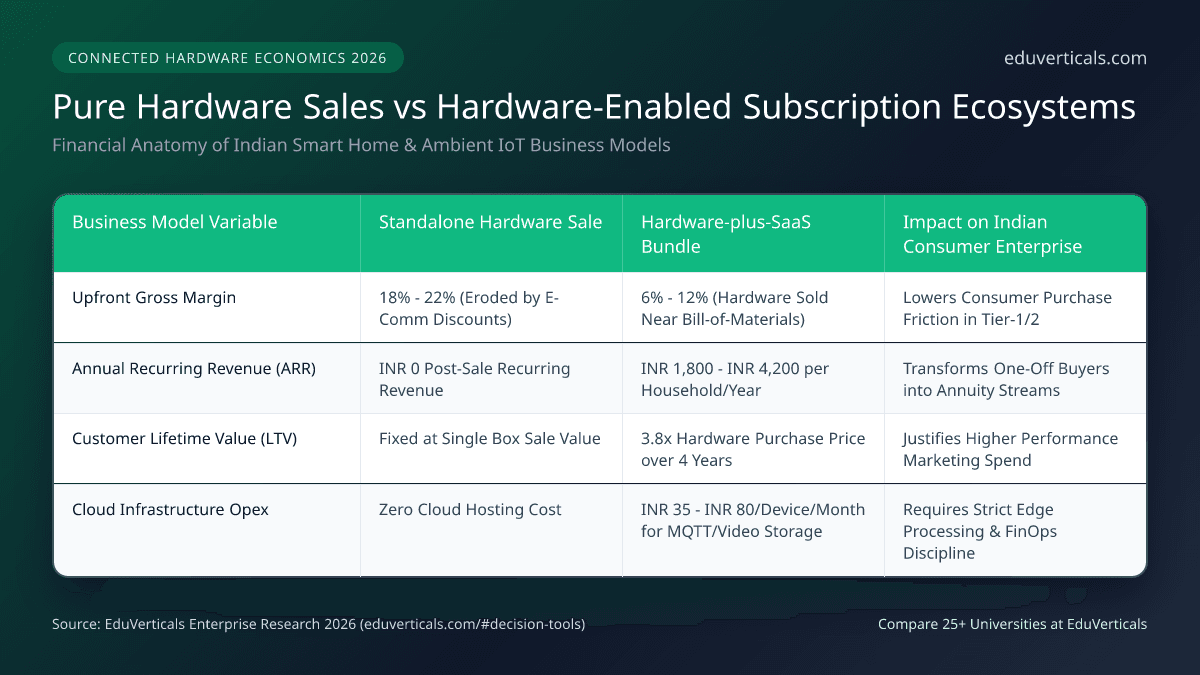
  • Subsidized Hardware Entry Points: Selling an advanced smart security hub at ₹2,499 (near its ₹2,200 bill-of-materials cost) eliminates initial consumer friction in Tier-1 and Tier-2 Indian cities, accelerating household penetration.
  • The Value-Add AI Tier: Basic live video streaming and motion alerts remain free, but advanced capabilities—such as facial recognition, vehicle number plate identification, pet activity detection, and 30-day encrypted rolling cloud backups—require a ₹199 to ₹349 monthly subscription.
  • UPI AutoPay & E-Mandate Integration: Historically, subscription businesses in India suffered 40% to 50% monthly churn due to credit card friction. The widespread adoption of UPI AutoPay with automated WhatsApp renewal notifications has lowered payment failure rates to under 6%.
  • B2B2C Gated Community Bundling: Leading smart security players partner directly with residential welfare associations (RWAs) and gated township societies (MyGate, NoBrokerHood), embedding subscription fees directly into monthly maintenance bills.
Ambient IoT Smart Home Hardware Subscription Economics India 2026
Comparison of pure hardware sales versus hardware-enabled subscription business models across gross margins, ARR, and LTV.

2. Overcoming the Edge vs Cloud Infrastructure Dilemma

For Chief Technology Officers and Product Operations leaders, scaling ambient IoT fleets requires rigorous architectural optimization to prevent cloud hosting bills from consuming subscription gross margins.

  1. Edge AI Video Processing: Executing neural computer vision models directly on device-side NPUs (such as Ambarella or MediaTek edge chipsets). Instead of streaming continuous 4K video feeds to the cloud, the device processes frames locally and streams only 10-second compressed event clips when anomalous activity is detected.
  2. Matter & Thread Interoperability: Standardizing on Matter over Thread protocols allows ambient sensors to communicate locally over mesh radio networks without routing every internal sensor handshake through public cloud servers, slashing bandwidth overhead.
  3. Cold-Storage Data Tiering: Archiving encrypted video telemetry onto low-cost cloud object storage tiers (AWS Glacier Instant Retrieval or Cloudflare R2) while maintaining immediate accessibility for customer playback requests.
  4. Hardware Working Capital Optimization: Structuring supply chain vendor financing to match component inventory purchase cycles with customer upfront annual subscription cash collections.
Interactive Career Pulse

Select your career goal to tailor advice

Decision note · Verified comparison01 / 03

What is your primary career challenge in IoT, hardware, and connected tech?

Mentor RecommendationTransitioning from Embedded Firmware to Product Management

Build formal expertise in SaaS unit economics and product pricing. Compare top executive programs on EduVerticals University Compare.

Tailored shortlist from our admission partners

3. Why Hardware Leaders Must Master Recurring Business Economics

Managing an ambient IoT business unit requires a fundamentally different leadership mindset than running a traditional manufacturing plant. A Vice President of IoT must understand firmware over-the-air release trains, hardware yield learning curves, recurring subscription cohort churn, customer acquisition payback periods, and statutory privacy compliance under the DPDPA.

Engineers and technical project leads who combine domain hardware depth with formal postgraduate business education are uniquely positioned to lead this multi-billion-dollar market. Pursuing an accredited Online MBA in Operations & Technology Management from premier institutions like NMIMS Global Access or Symbiosis Centre for Distance Learning provides the strategic, financial, and operational mastery needed to scale connected device enterprises.

Editorial Brief
Reading Brief
Bridge Engineering Execution with Business Leadership: Explore specialized management programs designed for working engineers and connected hardware professionals on .

Keep the details close

Common QuestionsThe full picture.

Explore key programme specifications, recognition terms, fee components, and career outcomes side by side before applying.

05 verified FAQs

Ambient IoT refers to low-power, continuously connected sensors and devices that seamlessly monitor environmental conditions (air quality, temperature, security, energy) without requiring active user intervention. Urban Indian households are adopting these to address home security, pollution, and energy costs.

01 / The Facts, Side by Side
Live Comparison Dossier

University Comparison Report

Bring programme options, estimated fees and study flexibility into one view, with the trade-offs and questions to verify.

01Fee Structure
02Study Mode
03Career Fit

Tailored shortlist from our admission partners. Verify fees and eligibility before applying.

Meet Our Mentors

We have a team of over 12 experienced mentors with over 26+ years of collective experience available to guide you at a moment's notice.

Got Questions?

Online and distance learning programs provide: - Flexibility to learn at your own pace from anywhere. - Access to recorded lectures and digital study materials. - Opportunities to balance work, education, and personal commitments. - Affordable options compared to traditional on-campus programs. - Industry-relevant curriculum designed by academic experts.
Choosing the right university depends on: - Accreditation and recognition of the institution. - Quality and relevance of the curriculum. - Availability of academic and career support services. - Feedback and reviews from alumni and current students. - Flexibility in learning schedules and delivery modes.
Yes, online degrees from accredited universities are widely recognized and equivalent to regular degrees. Employers value the skills and qualifications gained from online programs, especially when offered by reputed institutions.
Assessment methods for online programs vary but typically include: - Online quizzes and assignments. - Virtual proctored exams. - Group projects and case studies. - Real-time presentations and viva sessions.
Many universities allow credit transfers, subject to: - Compatibility with the curriculum of the new program. - A minimum grade requirement in previously completed courses. - Approval by the academic administration of the new university.