
logo

Apple M5 vs Neural PCs: Enterprise IT Hardware Procurement & TCO Strategy (2026)

Apple M5 EnterpriseNeural PCs NPUIT Hardware ProcurementEnterprise TCO FinOpsLocal AI Inference CapexIT Leadership MBAEduVerticals
EduVerticals EditorialsEduVerticals Editorials

Posted 1 day ago

Apple M5 vs Neural PCs: Enterprise IT Hardware Procurement & TCO Strategy (2026)
Executive Summary
Reading Brief
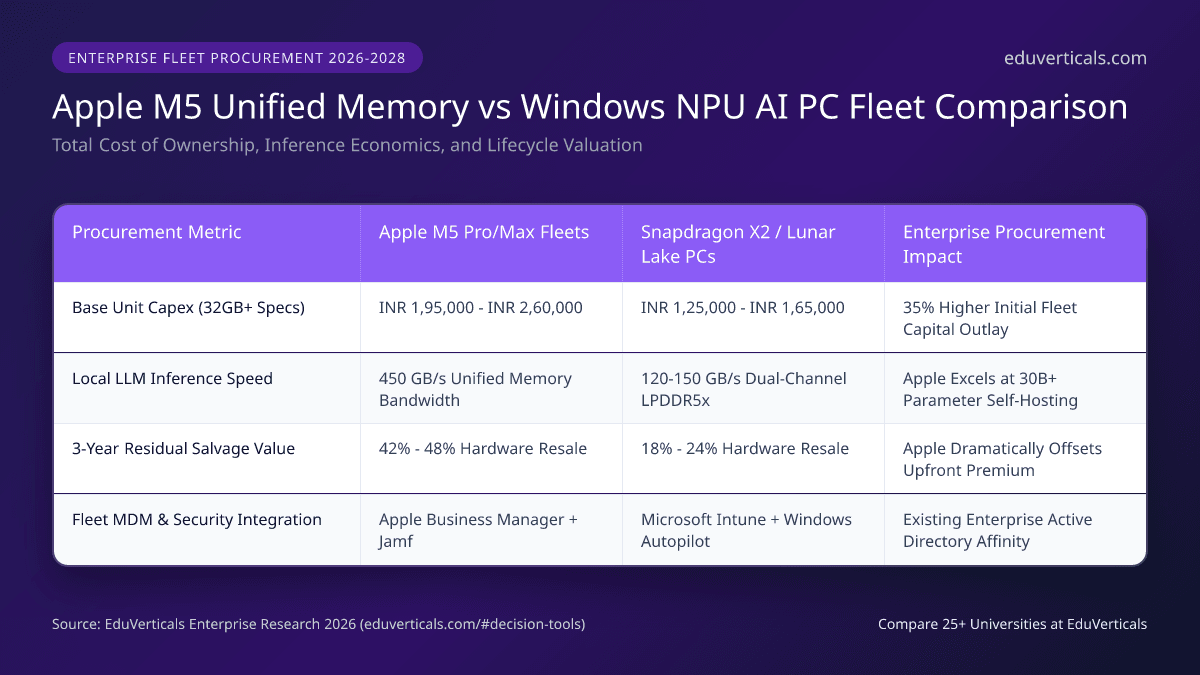
Executive Summary: The enterprise IT hardware refresh cycle of late 2026 presents Chief Information Officers and procurement directors with a high-stakes capital allocation dilemma: should they outfit corporate knowledge workers with Apple Silicon M5 workstations featuring massive unified memory architectures, or deploy Windows Neural PCs powered by Qualcomm Snapdragon X2 and Intel Core Ultra (Lunar Lake/Panther Lake) chips? While Apple machines carry a 35% upfront procurement premium, their 450 GB/s unified memory bandwidth allows local execution of 30-billion-parameter open-weight AI models without incurring cloud API costs. For a 2,500-seat engineering enterprise, running local inference can slash monthly cloud LLM operational expenditure by ₹40 Lakhs to ₹1.2 Crore, transforming a simple hardware procurement decision into a masterclass in corporate FinOps and Total Cost of Ownership (TCO) modeling.

For decades, enterprise workstation procurement followed a standardized formula: IT procurement managers negotiated bulk discounts with Dell, Lenovo, or HP on generic x86 corporate laptops, refreshed the fleet every 36 to 48 months, and depreciated the assets linearly on corporate balance sheets. However, the generative AI boom has completely disrupted this commoditized cycle.

Knowledge workers, data scientists, and software developers now execute continuous AI-assisted workflows—from automated code refactoring and local telemetry summarization to synthetic test generation. Running millions of daily token queries through centralized frontier cloud APIs (such as OpenAI or Anthropic) introduces massive operational latency, regulatory data leakage concerns under the DPDPA, and skyrocketing monthly cloud bills. As a result, the workstation has evolved from a passive client endpoint into a distributed edge inference node.

1. FinOps Math: Local Inference Capex vs Cloud API Opex

The financial justification for premium AI workstations cannot be evaluated through purchase price alone. An enterprise procurement director must model multi-year capital expenditure (Capex) against continuous operational expenditure (Opex).

Consider an enterprise engineering organization with 1,000 software developers:
  • The Cloud API Scenario: Each engineer consumes approximately 600,000 tokens daily via cloud coding assistants and debugging agents. At blended enterprise API rates of $4 per million tokens, the monthly cloud inference bill totals roughly $72,000 (₹60 Lakhs), amounting to over ₹7.2 Crore annually in pure operational burn.
  • The Local M5 / NPU Workstation Scenario: By outfitting engineers with 64GB unified memory Apple M5 or premium Snapdragon X2 workstations, 70% of routine token workloads (syntax completion, code analysis, internal documentation lookup) run locally on-device via quantized open-weight models (Llama 3.3 8B/70B, Mistral).
  • Net Operational Savings: Cloud API expenditure drops to under ₹2 Crore annually, generating ₹5.2 Crore in yearly recurring opex savings. Over a 3-year refresh cycle, the cumulative savings completely offset the upfront hardware acquisition cost of the entire fleet.
  • Latency and Productivity Gains: Local inference eliminates WAN round-trip latency, reducing code completion latency from 1,200ms to sub-80ms and boosting developer focus and flow states.
AI Workstations Apple M5 vs Neural PCs Enterprise IT Procurement 2026
Enterprise fleet procurement matrix comparing Apple M5 and Windows Neural PCs across Capex, inference bandwidth, salvage value, and TCO.

2. Total Cost of Ownership (TCO) & Residual Salvage Realities

Beyond inference performance, seasoned IT directors evaluate lifecycle economics, employee retention, and residual asset recovery.

  1. Secondary Market Residual Value: Historical enterprise lease data confirms that enterprise MacBooks retain between 42% and 48% of their original acquisition value after 36 months, compared to only 18% to 24% for equivalent x86 corporate laptops. Selling off-lease hardware back to refurbishers significantly recovers capital.
  2. IT Support Ticket Velocity: Enterprises running modern Apple Silicon fleets consistently report a 40% reduction in hardware failure rates, battery replacements, and OS crash tickets, dramatically reducing the helpdesk staffing ratio per 1,000 seats.
  3. Talent Acquisition & Offer Acceptance: In India’s fiercely competitive software engineering market, offering prospective senior engineers high-end Apple hardware increases offer-acceptance rates and reduces early onboarding churn.
  4. Security and Management Overhead: Windows Neural PCs still hold an operational advantage in traditional corporate environments tightly coupled with Microsoft Intune, Active Directory Group Policy, and legacy proprietary ERP applications.
Interactive Career Pulse

Select your career goal to tailor advice

Decision note · Verified comparison01 / 03

What is your primary career focus in enterprise IT procurement and infrastructure?

Mentor RecommendationMastering Cloud FinOps & Hardware TCO

Develop quantitative capital budgeting and vendor negotiation skills. Review accredited online degrees on EduVerticals University Compare.

Tailored shortlist from our admission partners

3. Why Procurement Leaders Need Advanced Financial Modeling Skills

The era of the "purchasing manager" who simply collects vendor quotes and negotiates a 5% discount is over. Modern IT procurement leaders must operate as strategic capital allocators, working hand-in-hand with the CFO and CTO to optimize tax depreciation schedules, lease-versus-buy financing structures, and dynamic cloud consumption models.

To achieve this level of executive impact, technology professionals must develop advanced financial literacy and corporate strategy competencies. Enrolling in an accredited Online MBA in Supply Chain & Operations Management or Technology Management degree from premier institutions such as Manipal University Jaipur (MUJ) or exploring executive options in our Course Catalog provides the analytical horsepower required to lead multi-crore enterprise procurement transformations.

Editorial Brief
Reading Brief
Elevate Your IT Management Career: Calculate the multi-year ROI of an accredited executive management degree tailored for technology leaders on .

Keep the details close

Common QuestionsThe full picture.

Explore key programme specifications, recognition terms, fee components, and career outcomes side by side before applying.

05 verified FAQs

Apple M5 leverages high-speed Unified Memory Architecture (UMA) with up to 450 GB/s bandwidth accessible jointly by CPU, GPU, and Neural Engine, while Windows Neural PCs rely on dedicated NPUs paired with standard dual-channel LPDDR5x RAM.

01 / The Facts, Side by Side
Live Comparison Dossier

University Comparison Report

Bring programme options, estimated fees and study flexibility into one view, with the trade-offs and questions to verify.

01Fee Structure
02Study Mode
03Career Fit

Tailored shortlist from our admission partners. Verify fees and eligibility before applying.

Meet Our Mentors

We have a team of over 12 experienced mentors with over 26+ years of collective experience available to guide you at a moment's notice.

Got Questions?

Online and distance learning programs provide: - Flexibility to learn at your own pace from anywhere. - Access to recorded lectures and digital study materials. - Opportunities to balance work, education, and personal commitments. - Affordable options compared to traditional on-campus programs. - Industry-relevant curriculum designed by academic experts.
Choosing the right university depends on: - Accreditation and recognition of the institution. - Quality and relevance of the curriculum. - Availability of academic and career support services. - Feedback and reviews from alumni and current students. - Flexibility in learning schedules and delivery modes.
Yes, online degrees from accredited universities are widely recognized and equivalent to regular degrees. Employers value the skills and qualifications gained from online programs, especially when offered by reputed institutions.
Assessment methods for online programs vary but typically include: - Online quizzes and assignments. - Virtual proctored exams. - Group projects and case studies. - Real-time presentations and viva sessions.
Many universities allow credit transfers, subject to: - Compatibility with the curriculum of the new program. - A minimum grade requirement in previously completed courses. - Approval by the academic administration of the new university.