
logo

AI Strategy Decks vs Boardroom P&L Ownership: Executive Leadership (2026)

AI Strategy DecksBoardroom PnL OwnershipExecutive Leadership 2026Change Management TechCXO Career ProgressionOnline MBA LeadershipEduVerticals
EduVerticals EditorialsEduVerticals Editorials

Posted 1 day ago

AI Strategy Decks vs Boardroom P&L Ownership: Executive Leadership (2026)
Executive Summary
Reading Brief
Executive Summary: In the corporate world of late 2026, a profound shift has redefined executive evaluation: generative artificial intelligence has rendered the production of polished 50-slide strategy presentations completely trivial. An entry-level analyst using automated reasoning agents can synthesize competitor financials, map Porter’s Five Forces, and generate an impeccably styled executive slide deck in under eight minutes. Consequently, the market clearing price for "slide-deck strategists" has collapsed to zero. In boardrooms across Mumbai, Bengaluru, Singapore, and New York, Chief Executive Officers and Nomination & Remuneration Committees (NRCs) are filtering ruthlessly for leaders who possess what no software model can automate: authentic operational accountability, cross-functional political alignment, change management grit, and hard P&L ownership.

The disconnect between presentation strategy and operational reality reached epidemic proportions during the 2024–2025 technology hype cycle. Management consultants and internal strategy teams presented breathtaking decks outlining multi-million-dollar AI transformations. Yet when board members inspected balance sheets eighteen months later, they found zero measurable impact on operating margins, working capital cycles, or revenue velocity. The projects had stalled in execution because strategy decks do not navigate departmental turf wars, negotiate vendor contracts, or rally cynical frontline sales and factory teams.

By November 2026, enterprise boards across Corporate India have instituted an uncompromising promotion filter. Mid-level managers seeking elevation to Vice President, General Manager, or Business Unit Head can no longer rely on eloquent PowerPoint commentary. They are being evaluated on a single, binary criterion: can you take direct fiduciary ownership of a ₹25 Crore to ₹100 Crore operational P&L and deliver audited cash EBITDA? Those who can command generational compensation; those who cannot remain permanently stuck in advisory staff roles.

1. The Commoditization of Strategy: Why Slides No Longer Impress Boards

To understand why slide-deck strategy lost its executive currency, one must examine how automated analytical tools democratized traditional business consulting frameworks:
  • Instant Framework Synthesis: Automated reasoning models ingest hundreds of industry reports and generate flawless SWOT analyses, Boston Consulting Group (BCG) growth-share matrices, and market entry frameworks on demand.
  • The Illusion of Certainty: AI slide generators create beautifully formatted financial projections that look authoritative on a screen, but completely ignore real-world supply chain bottlenecks, regulatory friction, and organizational resistance.
  • Execution Paralysis: Organizations with excessive deck-builders suffer from "analysis paralysis," where managers spend months endlessly tweaking slide aesthetics rather than conducting gritty customer pilots and operational experiments.
  • The Human Resistance Bottleneck: Every corporate transformation fails or succeeds based on human psychology. An algorithm cannot persuade a unionized factory floor or a veteran field sales force to adopt new operational software; that requires empathetic, battle-tested managerial leadership.
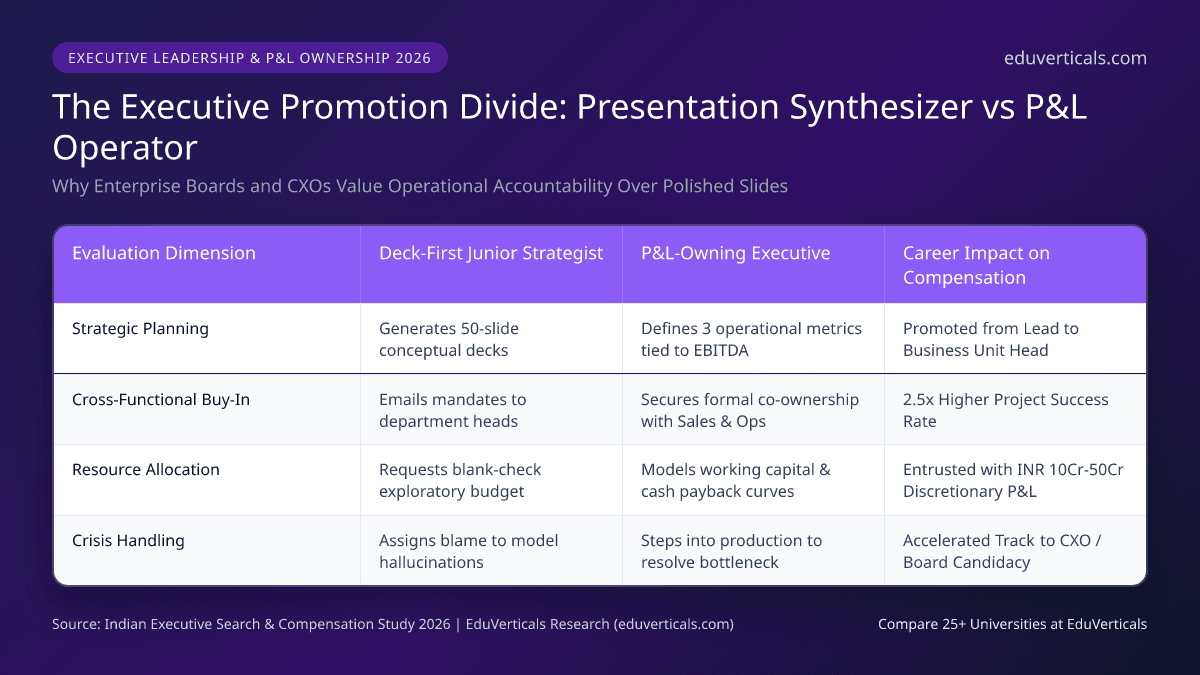
Executive Promotion Divide Presentation Synthesizer vs PnL Operator 2026
Executive Leadership Promotion Divide: Contrasting Slide-Deck Synthesizers with Authentic P&L Operators.

2. The Four Disciplines of Authentic Enterprise P&L Ownership

True P&L leaders do not view strategy as an intellectual exercise; they view it as the disciplined allocation of scarce corporate capital. As explored in our landmark analysis, Will AI Replace the MBA Degree?, boardroom credibility is constructed upon four operational competencies:

  1. Balance Sheet and Working Capital Mastery: Understanding how every operational decision impacts days sales outstanding (DSO), inventory holding costs, and free cash flow generation.
  2. Cross-Functional Coalition Building: Securing genuine, enthusiastic buy-in from skeptical departmental peers in Legal, Sales, Procurement, and HR before presenting initiatives to CXOs.
  3. Relentless Change Management: Designing incentive structures, training programs, and cultural reinforcement mechanisms that drive lasting behavioral change across hundreds of employees.
  4. Crisis Accountability: Stepping forward into operational fires when supply chains fail or software systems glitch, taking personal responsibility, and rapidly engineering practical solutions.
Interactive Career Pulse

Select your career goal to tailor advice

Decision note · Verified comparison01 / 03

What is your primary focus when presenting initiatives to senior executive leadership?

Mentor RecommendationVisualizing Concepts & Architecture

Transition rapidly from theoretical slide decks to balance sheet cash flows and payback timelines. Check our University Comparison Report to strengthen your quantitative financial fluency.

Tailored shortlist from our admission partners

3. How Managers Build Authentic P&L Acumen via an Online MBA

The transition from technical lead or functional specialist to P&L-owning executive is the most lucrative career leap in Corporate India. General Managers and Business Unit Heads commanding direct P&Ls routinely earn compensation packages ranging from ₹55 LPA to ₹1.2 Crore + profit-share bonuses across multinational GCCs, manufacturing conglomerates, and tech enterprises.

To bridge this capability gap, ambitious managers are pursuing accredited postgraduate management credentials. Programs like the Symbiosis Centre for Distance Learning (SCDL) Online Executive Management Program provide the comprehensive grounding in managerial finance, organizational behavior, corporate law, and strategic leadership needed to command boardroom respect.

  • Move from Staff Advisor to Line Operator: Stop advising other people how to run businesses; take personal ownership of revenues, costs, and team culture.
  • Explore Accredited University Portfolios: Inspect comprehensive curriculum breakdowns on the EduVerticals Academic Catalog to choose an institution aligned with your corporate goals.
  • Model Your Long-Term ROI: Evaluate how an accredited executive degree impacts your five-year salary progression via .

Keep the details close

Common QuestionsThe full picture.

Explore key programme specifications, recognition terms, fee components, and career outcomes side by side before applying.

05 verified FAQs

Boards recognize that AI tools have made slide generation effortless, but presentation decks do not execute strategy. Real corporate value is created exclusively by leaders who can align cross-functional human teams and deliver audited P&L outcomes.

01 / The Facts, Side by Side
Live Comparison Dossier

University Comparison Report

Bring programme options, estimated fees and study flexibility into one view, with the trade-offs and questions to verify.

01Fee Structure
02Study Mode
03Career Fit

Tailored shortlist from our admission partners. Verify fees and eligibility before applying.

Meet Our Mentors

We have a team of over 12 experienced mentors with over 26+ years of collective experience available to guide you at a moment's notice.

Got Questions?

Online and distance learning programs provide: - Flexibility to learn at your own pace from anywhere. - Access to recorded lectures and digital study materials. - Opportunities to balance work, education, and personal commitments. - Affordable options compared to traditional on-campus programs. - Industry-relevant curriculum designed by academic experts.
Choosing the right university depends on: - Accreditation and recognition of the institution. - Quality and relevance of the curriculum. - Availability of academic and career support services. - Feedback and reviews from alumni and current students. - Flexibility in learning schedules and delivery modes.
Yes, online degrees from accredited universities are widely recognized and equivalent to regular degrees. Employers value the skills and qualifications gained from online programs, especially when offered by reputed institutions.
Assessment methods for online programs vary but typically include: - Online quizzes and assignments. - Virtual proctored exams. - Group projects and case studies. - Real-time presentations and viva sessions.
Many universities allow credit transfers, subject to: - Compatibility with the curriculum of the new program. - A minimum grade requirement in previously completed courses. - Approval by the academic administration of the new university.