 EduVerticals Editorials
Posted 4 months ago
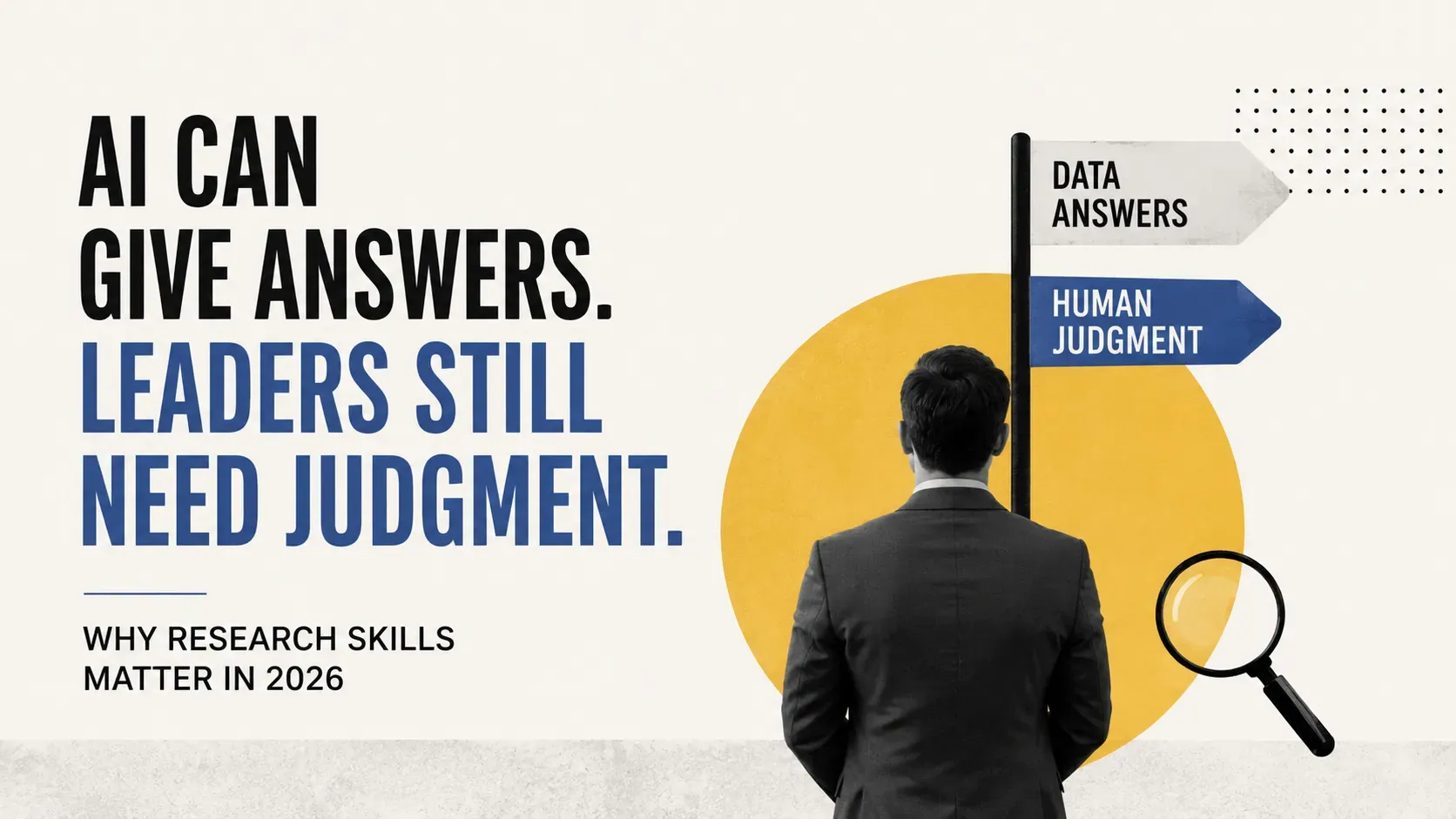
Artificial intelligence has changed the way organisations operate.
Today, executives can generate reports, analyse data, create presentations, forecast trends, and automate workflows in minutes using AI-powered tools. Information that once required teams of analysts and weeks of effort is now available almost instantly.
But while AI has made answers easier to obtain, it has created a new challenge for leaders:
In 2026, leadership is no longer defined by access to information. It is defined by the ability to evaluate information, challenge assumptions, identify risks, and make sound strategic decisions.
This is why research skills are becoming one of the most valuable leadership capabilities in the age of AI.
For decades, executives were valued for their experience, expertise, and ability to access information.
Today, information has become abundant.
Anyone can ask an AI tool:
- What market should we enter?
- How should we price our product?
- What organisational structure should we adopt?
- What trends will affect our industry?
Within seconds, AI can generate detailed responses.
The problem is that AI does not truly understand business context.
It predicts answers based on patterns.
Leaders, however, are responsible for decisions that affect people, investments, organisations, and long-term strategy.
This means executives must go beyond simply accepting AI-generated outputs.
They must evaluate them critically.
Many people assume artificial intelligence will reduce the need for research.
The opposite is happening.
As AI-generated content becomes more widespread, leaders need stronger research skills to separate valuable insights from inaccurate conclusions.
Research skills help executives:
- Verify information
- Evaluate sources
- Identify bias
- Test assumptions
- Analyse competing viewpoints
- Understand cause-and-effect relationships
- Make evidence-based decisions
Without these capabilities, organisations risk making decisions based on incomplete or misleading information.
In the AI era, research is no longer an academic exercise.
It has become a competitive advantage.
Modern organisations generate enormous amounts of data.
The challenge is not obtaining data.
The challenge is interpreting it correctly.
A leader who can ask the right questions often creates more value than one who simply receives more information.
Research-oriented leaders are trained to investigate problems systematically.
They understand how to:
- Define business challenges
- Collect relevant evidence
- Evaluate findings
- Draw meaningful conclusions
- Translate insights into action
These skills are becoming increasingly important as businesses navigate digital transformation and AI adoption.
Artificial intelligence can identify patterns.
It cannot fully understand human behaviour, organisational culture, ethics, stakeholder interests, or long-term business consequences.
For example:
An AI system may recommend reducing workforce costs to improve profitability.
A leader must consider:
- Employee morale
- Brand reputation
- Customer impact
- Regulatory implications
- Long-term organisational health
AI provides information.
Leaders provide judgment.
The organisations that thrive in the coming decade will combine both.
One of the biggest shifts happening in executive education is the move toward evidence-based leadership.
Instead of relying solely on intuition or past experience, modern leaders are expected to support decisions using research, data, and analysis.
This approach helps organisations:
- Reduce uncertainty
- Improve strategic planning
- Increase accountability
- Strengthen innovation
- Improve organisational performance
As markets become more complex, evidence-based leadership is becoming a critical differentiator.
This shift helps explain the growing interest in Doctor of Business Administration (DBA) programmes among senior professionals.
Unlike traditional academic research degrees, a DBA focuses on applying research to real business challenges.
Executives learn how to:
- Conduct business research
- Evaluate complex organisational problems
- Analyse data effectively
- Develop evidence-based strategies
- Drive organisational transformation
In many ways, the DBA prepares leaders for exactly the type of environment AI is creating.
An environment where information is abundant but sound judgment remains scarce.
The rise of artificial intelligence has sparked concerns about automation and job displacement.
While many operational tasks will continue to be automated, leadership itself is evolving rather than disappearing.
Future leaders will spend less time gathering information and more time:
- Interpreting insights
- Asking better questions
- Managing uncertainty
- Evaluating risks
- Driving innovation
- Making ethical decisions
These responsibilities require critical thinking, research capability, and strategic judgment.
Skills that AI cannot fully replicate.
To remain effective in an AI-driven business environment, leaders should focus on developing:
Research Literacy
The ability to evaluate evidence and assess information quality.
Strategic Thinking
The capability to connect insights with long-term business objectives.
Data Interpretation
Understanding how to transform data into meaningful decisions.
Critical Thinking
Questioning assumptions and identifying weaknesses in proposed solutions.
Continuous Learning
Keeping pace with technological and business change.
These competencies will increasingly separate effective leaders from average managers.
Artificial intelligence is transforming the way organisations access information, analyse data, and make decisions.
But the most important leadership skill in 2026 is not knowing how to use AI.
It is knowing how to think beyond it.
As information becomes cheaper and more accessible, judgment becomes more valuable.
The leaders who succeed in the AI era will not necessarily be those with the most data.
They will be those who can ask better questions, evaluate evidence critically, and make informed decisions when the answers are unclear.AI can provide recommendations.
Leadership still requires research, reasoning, and judgment.


We have a team of over 12 experienced mentors with over 26+ years of collective experience available to guide you at a moment's notice.