 Aditi Chouri
 Posted 8 months ago

The Master of Computer Applications degree has long been respected in India as a pathway into the technology sector. Traditionally oriented around foundational computer science subjects such as programming, database systems, and networking, MCA programmes are now evolving rapidly. The explosion of new technologies and industries means that students no longer compete with general computing knowledge alone. Employers increasingly seek professionals with specialised expertise in niche technology areas that match real world business needs. This shift has led Indian universities and institutes to offer new and emerging specialisations within the MCA curriculum. These specialisations aim to prepare graduates for specific career paths, enhancing employability and relevance in a competitive job market.
This blog explores the emerging MCA specialisations in India in detail. We will describe what each specialisation entails, why it is in demand, what technologies and skills it covers, and the kinds of roles graduates can expect after completion. To make this guide practical and easy to use, we have included examples and comparative tables. At the end, you will also find a set of frequently asked questions that address common concerns about MCA specialisations.
Traditional MCA programmes focused on foundational subjects that provided a broad base of knowledge in computing. While that base remains important, the rapid pace of technological advancement means that many industries now require deeper understanding of specialised topics. For example, knowing only programming languages without understanding how to apply them to machine learning problems is no longer sufficient for roles in artificial intelligence. Similarly, cybersecurity challenges in businesses today require graduates who can think like defenders and attackers, not just write code.
Here are key reasons why specialisation matters:
1. Industry Relevance
Employers value graduates who can contribute from day one. Specialised knowledge in cloud computing, data science, or cybersecurity signals that a candidate can solve real business problems immediately.
2. Focused Learning
Specialisation directs learning toward specific technologies and tools, preventing students from spending excessive time on generic topics that have less relevance in today’s job market.
3. Career Clarity
Graduates with a clear specialisation are better positioned to choose career paths and roles that match their interests, rather than competing broadly in a crowded field.
4. Higher Salary Prospects
Specialised skills often command higher salaries because they are rarer and more in demand.
Now we will explore the most prominent and emerging MCA specialisations in India.
Artificial Intelligence and Machine Learning is one of the most sought after specialisations in modern computing. It trains students to design systems that can learn from data and make intelligent decisions with minimal human intervention.
What you learn:
Why It Is in Demand
AI and ML technologies power applications ranging from chatbots to recommendation systems and autonomous vehicles. Businesses in healthcare, finance, retail, and media integrate AI to drive efficiency and innovation.
Example Roles:
Real World Example
A healthcare company might use machine learning models to analyse patient data and predict diseases at initial stages, improving diagnosis accuracy.
Cybersecurity focuses on protecting systems, data, and networks from threats and attacks. It combines defensive strategies, vulnerability assessment, and ethical hacking techniques.
What You Learn
Why It Is in Demand
As organisations move toward digital transformation, cyber threats have increased. Securing sensitive information and IT infrastructure is not optional, and businesses need experts who can protect against data breaches, ransomware, and digital espionage.
Example Roles:
Real World Example
A financial institution may employ cybersecurity specialists to monitor traffic and detect suspicious login attempts, preventing unauthorized access to customer accounts.
Cloud computing has become a cornerstone of modern IT infrastructure. Organisations large and small depend on cloud platforms for scalable and cost effective computing services.
What You Learn
Why It Is in Demand
The cloud has replaced traditional on site servers in many businesses. Cloud professionals enable businesses to scale operations, reduce infrastructure costs, and maintain flexibility.
Example Roles:
Real World Example
An ecommerce platform that experiences seasonal traffic spikes might use cloud services to scale computing resources during peak shopping periods.
This specialisation equips students with techniques to extract insights from vast volumes of data using statistical methods and machine learning.
What You Learn
Why It Is in Demand
Nearly every industry today uses data to drive decision making. Insights from large datasets help businesses optimise processes, understand customer behaviour, and develop strategic plans.
Example Roles:
Real World Example
A retail chain might analyse point of sale data to tailor product offerings in different regions based on purchasing patterns.
Full stack development continues to be relevant because it covers both frontend and backend application development. Graduates learn to build complete software applications from end to end.
What You Learn
Why It Is in Demand
Companies that build web based services need professionals who understand the entire development process and can work on multiple layers of applications.
Example Roles:
Real World Example:
A startup building an online learning platform may need full stack developers to implement user interfaces, integrate databases, and ensure secure login systems.
Mobile applications are central to digital consumer experiences. This specialisation trains students to develop applications for mobile platforms.
What You Learn
Why It Is in Demand
Smartphones are ubiquitous. Businesses in entertainment, finance, education, and health all build mobile apps to reach users directly and improve engagement.
Example Roles:
Real World Example:
A health startup may develop an app that tracks fitness metrics, integrates wearable data, and provides personalised health recommendations.
Blockchain technology is a decentralised ledger system that ensures secure and transparent transactions without intermediaries. It has applications beyond cryptocurrency.
What You Learn
Why It Is in Demand
Industries such as finance, supply chain, and governance are exploring blockchain to enhance transparency and security.
Example Roles:
Real World Example:
In supply chain management, blockchain can track the origin and movement of goods, reducing fraud and improving accountability.
The Internet of Things involves connecting physical devices to the internet so they can collect and exchange data. This specialisation blends hardware and software knowledge.
What You Learn
Why It Is in Demand
From smart homes to industrial automation, IoT is transforming everyday environments with connected devices that communicate and make decisions.
Example Roles:
Real World Example:
Smart cities use IoT sensors to manage traffic flow and reduce congestion by analysing real time data from road networks.
AR and VR technologies create immersive experiences by enhancing or simulating environments. These technologies are growing in entertainment, education, simulation training, and marketing.
What You Learn
Why It Is in Demand
The entertainment industry uses immersive content for gaming and virtual events. Education and training sectors use simulations for practice based learning where real world practice may be expensive or dangerous.
Example Roles:
Real World Example
A company training pilots might use VR simulations for practice before actual flight training, reducing risk and cost.
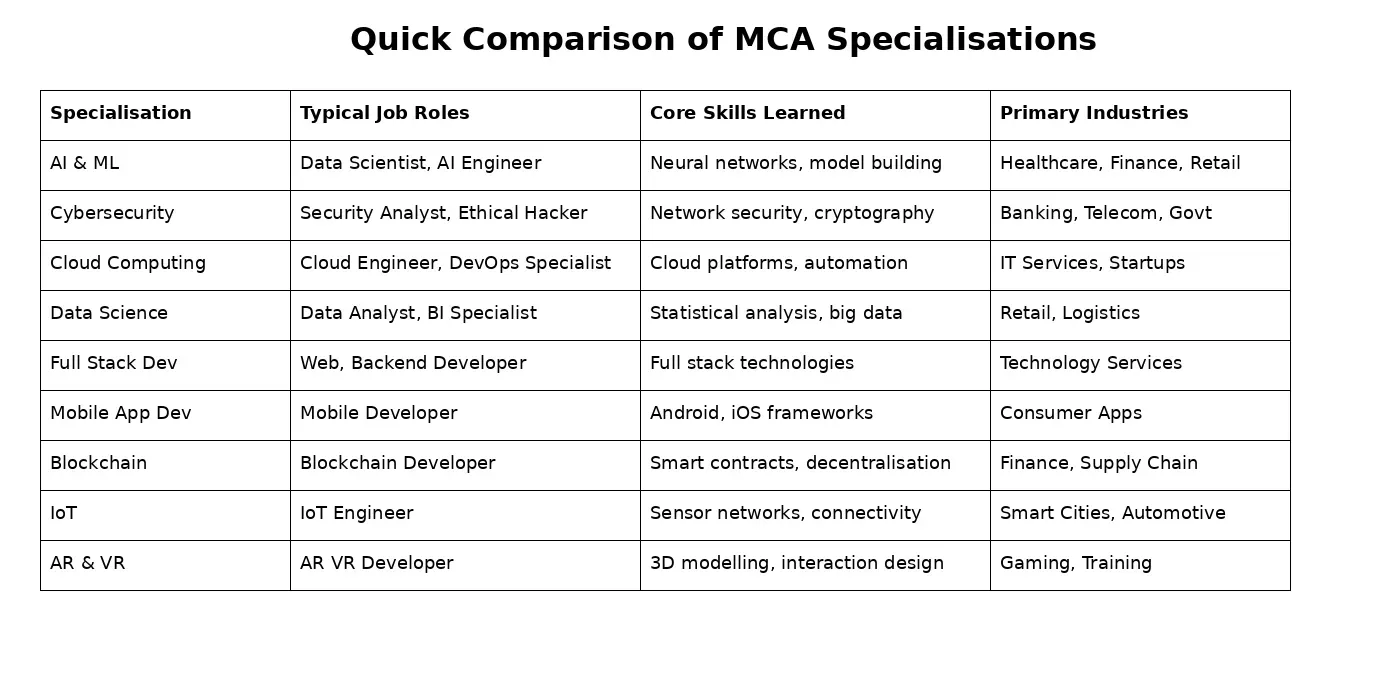
Selecting a specialisation depends on your interests, career goals, and strengths. Here are some guiding questions:
Understanding these aspects will help you choose a path that aligns with your skills and career aspirations.
1. Is specialisation mandatory in MCA programmes?
No. Some programmes offer general MCA without a specialisation. However, choosing a specialisation improves your job prospects and readiness for specialised roles.
2. Can I switch specialisations after joining a programme?
This depends on the university or institution. Some allow electives that can shift your focus, while others may require you to complete the chosen specialisation once enrolled.
3. Do employers value MCA specialisations?
Yes. Employers increasingly look for specialised graduates who can solve specific business problems. Specialisations demonstrate deeper expertise than general degrees.
4. Is it better to choose a technology specialisation or a development specialisation?
There is no one answer. It depends on your career goals. Technology specialisations like AI and cybersecurity prepare you for analytical or defensive roles. Development areas like full stack or mobile development suit those who enjoy building products.
5. Can I pursue certifications along with my MCA specialisation?
Yes. Certifications in relevant tools and platforms can further enhance your employability and help you stand out to employers.
The landscape of computing careers in India is actively evolving. Emerging MCA specialisations such as Artificial Intelligence, Cybersecurity, Cloud Computing, Data Science, and others reflect the shifting demands of the technology industry. By choosing a specialisation that aligns with your interests and the needs of the job market, you can position yourself for a rewarding and dynamic career.
Investing time in understanding these paths, building relevant skills, and gaining practical experience will prepare you not just for your first job, but for continued growth in a technology driven economy. As MCA evolves to include these specialised areas, students who embrace them will find themselves better equipped for the challenges and opportunities of the future.


We have a team of over 12 experienced mentors with over 26+ years of collective experience available to guide you at a moment's notice.